
Charleston County Circuit Court Overview
South Carolina's Circuit Court is a court of general jurisdiction. That means it can hear most types of cases that are not specifically assigned to another court by statute. In Charleston County, the Circuit Court operates out of the Judicial Center at 100 Broad Street in downtown Charleston. The Clerk of Court, Julie J. Armstrong, maintains both Circuit Court and Family Court records at that location. Common Pleas handles civil matters, and General Sessions handles felony and serious criminal prosecution. The court is not split into numbered divisions the way district courts are in some other states. Instead, resident and visiting judges rotate through court terms and handle the docket as assigned by the Chief Justice's order.
Family Court is a separate statewide trial court, not a division of the Circuit Court. That distinction matters. Divorce, custody, child support, orders of protection, and juvenile matters all go to Family Court, not to Common Pleas or General Sessions. Probate Court is also separate and deals with estates, wills, guardianships, and marriage licenses. If you are looking for a divorce record or an estate file, those do not live in the Circuit Court system. They sit with the Clerk's Family Court counter or with the Probate Judge's office, both at the Judicial Center.
The Clerk of Court forms page is one of the clearest starting points for understanding what Circuit Court handles and what forms a litigant may need to file.
A look at the Clerk of Court forms page shows the Circuit Court materials available to the public.
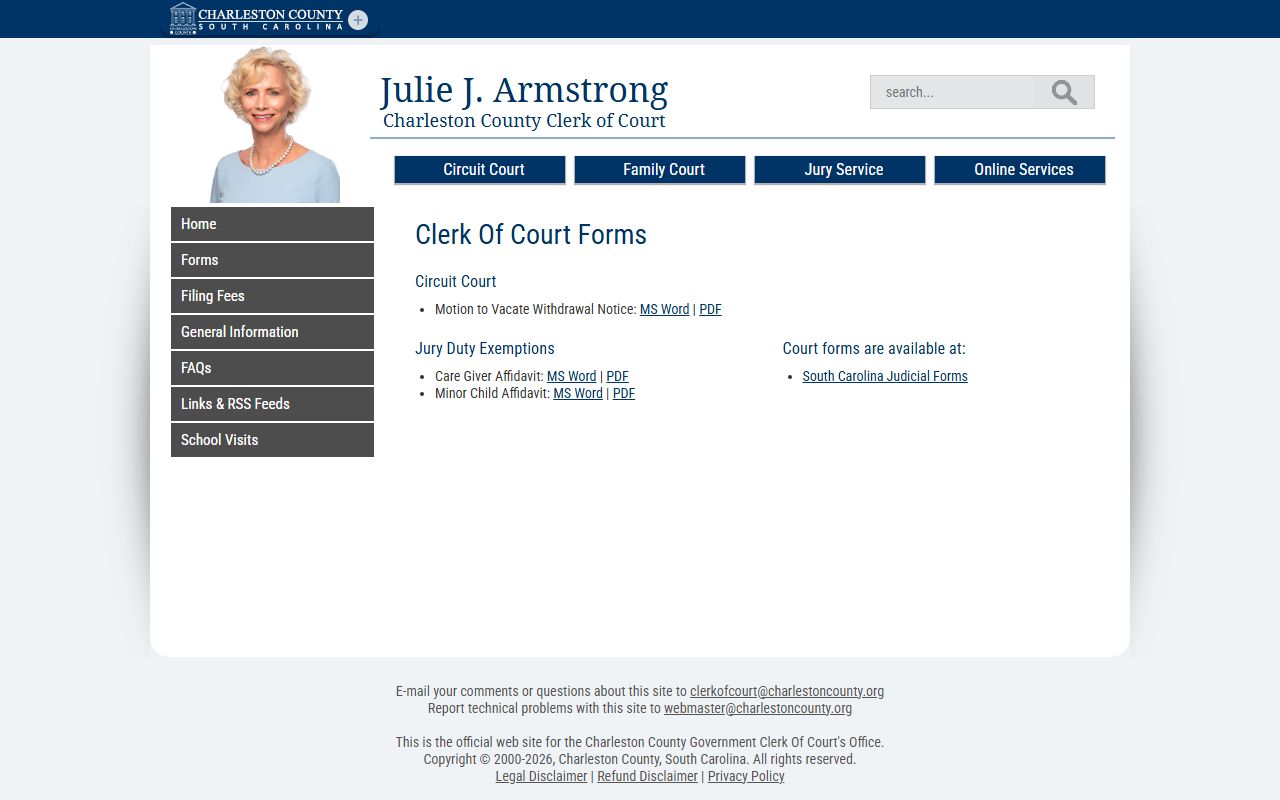
That page at charlestoncounty.gov links to Circuit Court forms, jury exemption affidavits, and the broader South Carolina Judicial forms library.
Common Pleas and General Sessions
The two divisions of the Charleston County Circuit Court cover almost all civil and criminal trial matters above the summary-court level. They share the same courthouse, the same clerk, and the same judges, but they handle completely different files.
Common Pleas is the civil division. It takes lawsuits where the amount in dispute exceeds what magistrates can hear, which in South Carolina is anything over $7,500. That includes contract disputes, personal injury cases, real property actions, civil appeals from magistrate or probate courts, and equitable claims. Common Pleas also receives lis pendens filings, transcripts of judgment, and satisfaction-of-judgment documents. Civil appeals from magistrate court, probate court, evictions, and some administrative agencies land in Common Pleas as well. The filing fee for most Common Pleas actions is $150. A lis pendens filed with the summons and complaint costs $150; a standalone lis pendens is just $10. Record retrieval from the Clerk runs $4 per record, and copies are $0.11 each.
General Sessions is the criminal division. It handles felony prosecutions and serious misdemeanor charges that are above the summary-court limit. After an arrest, the Magistrate Court handles the first appearance and bond. The case then moves to the Ninth Circuit Solicitor's Office for review. The Solicitor either presents the case to a grand jury for indictment or declines to proceed. Once indicted, the case is docketed in General Sessions for arraignment, pretrial motions, and trial or a plea. The Clerk receives criminal warrants and transmits them to the Solicitor. Criminal appeals from General Sessions go to the South Carolina Court of Appeals or, for certain matters, directly to the Supreme Court. Criminal appeals carry no filing fee.
The Ninth Circuit Solicitor's Office, scsolicitor9.org, prosecutes all General Sessions cases in Charleston and Berkeley Counties.
The Ninth Judicial Circuit
South Carolina divides its trial courts into sixteen judicial circuits. Charleston County sits in the Ninth Judicial Circuit along with Berkeley County. Circuit Court judges rotate through the county on terms set by the Supreme Court's scheduling order. The Ninth Circuit Solicitor serves both counties on the criminal side. Defendants with public-defender needs are served by the Charleston County Public Defender's office.
The state Judicial Branch publishes a roster of current Ninth Circuit judges, including both resident and assigned judges. That list is the most reliable source for current bench assignments because judge rotations change on state-level orders rather than county ones.
The Ninth Judicial Circuit judges page shows who is currently assigned to the circuit.
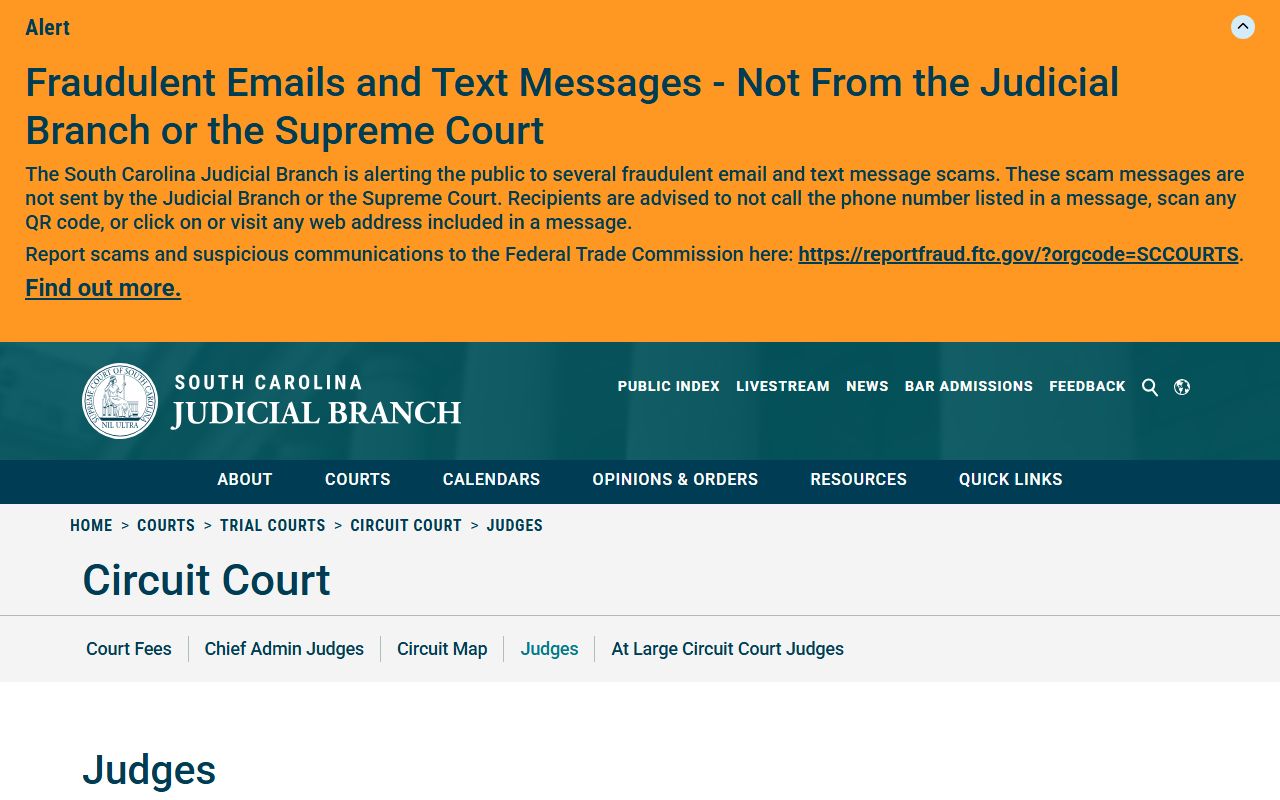
That page at sccourts.org lists judge names and current assignments for the circuit, which covers Charleston and Berkeley Counties.
Note: Judge assignments change when the Supreme Court issues new rotation orders, so verify current bench assignments through the Judicial Branch or Clerk's office before a court appearance.
How a Case Moves Through the Charleston County System
A civil case and a criminal case each follow a distinct path through the court system. They share some of the same players but move through different courts and procedures. Understanding the flow helps you know where a record would be at any given stage.
Civil flow: Complaint filed in Common Pleas › Defendant served and answers › Discovery and motions › Mediation where required › Trial or summary judgment › Judgment entered › Appeal to Court of Appeals or Supreme Court
Criminal flow: Arrest › Bond hearing at Centralized Bond Hearing Court › Case reviewed by Ninth Circuit Solicitor › Grand jury indictment or declination › Arraignment in General Sessions › Pretrial motions and hearings › Trial or plea › Sentencing › Appeal to Court of Appeals or Supreme Court
Magistrate appeal flow: Magistrate civil judgment › Appeal to Common Pleas › Common Pleas reviews on the record › Further appeal to Court of Appeals
Each stage generates its own records. Bond orders come from the magistrate level. Indictments are General Sessions documents. Pleadings, motions, and orders live in the Common Pleas or General Sessions docket depending on case type. The court dockets page explains how to read those event histories once you find a case in the Public Index.
Circuit Court vs. Magistrate Court vs. Municipal Court
Three court levels handle the bulk of regular litigation in Charleston County. Each has different civil-dollar limits, criminal jurisdiction, and appeal rules. The table below sets them side by side so you can tell at a glance where a case would normally be filed or heard.
| Feature | Circuit Court | Magistrate Court | Municipal Court |
|---|---|---|---|
| Civil dollar limit | No cap; general jurisdiction above $7,500 | Up to $7,500 | Varies by ordinance; no general civil docket |
| Criminal cases | Felonies and serious misdemeanors (General Sessions) | Fine up to $500 or up to 30 days, with statutory exceptions | City ordinances, traffic, lower criminal matters |
| Court of record | Yes | No | Varies |
| Small claims | No; cases over $7,500 only | Yes; disputes up to $7,500 | No |
| Bond hearings | No; magistrates set bond at first appearance | Yes; centralized bond court handles most first appearances | Municipal judges may set bond for city charges |
| Civil appeal goes to | Court of Appeals or Supreme Court | Common Pleas (Circuit Court) | Circuit Court |
| Records access | Public Index at jcmsweb.charlestoncounty.gov | Public Index or Summary Court Administration | Individual municipal court office |
Magistrates are not courts of record, which means the evidence and testimony are not preserved for direct appellate review the way a Circuit Court transcript would be. An appeal from a magistrate civil case goes to Common Pleas, and the Common Pleas judge reviews the matter fresh. That distinction also explains why a record from a magistrate case may look different from a Circuit Court file when you pull it from the Public Index.
Charleston County Magistrate and Summary Courts
Charleston County has 19 magistrates. They are appointed by the Governor with Senate advice and consent and serve four-year terms. The magistrate courts handle the front end of the criminal process, including first appearances and bond hearings, as well as the full docket of traffic tickets, small claims, landlord-tenant disputes, non-family restraining orders, and lower misdemeanors. Summary Court Administration, established in 1977, coordinates the county's summary courts from its North Charleston office. Bond hearings run on a set daily schedule at the Centralized Bond Hearing Court on Leeds Avenue. Preliminary hearings for General Sessions-bound cases go through the Centralized Preliminary Hearing Court, also on Leeds Avenue.
The table below lists each magistrate court in Charleston County with its assigned judge or judges, address, and phone number. Hours follow the standard county schedule of Monday through Friday, 8:30 a.m. to 4:30 p.m. with a midday lunch closure, except where noted. The Centralized Bond Hearing Court runs extended hours on weekdays and limited hours on weekends to process first appearances around the clock.
| Court | Judge(s) | Address | Phone |
|---|---|---|---|
| Summary Court Administration | Administrative office | 4045 Bridge View Dr., Suite B-143, North Charleston, SC 29405 | (843) 202-6600 |
| Centralized Bond Hearing Court | Magistrate Amanda Haselden; Magistrate Marcedes Smith | 3831 Leeds Ave., Suite 200, North Charleston, SC 29405 | (843) 746-9822 |
| Centralized Preliminary Hearing Court | Chief Magistrate JoAnna Summey-Hayes | 3831 Leeds Ave., Suite 100, North Charleston, SC 29405 | (843) 745-2390 |
| City of Charleston Magistrate Court | Magistrate Lauren Fox | 101 Meeting St., 3rd Floor, Charleston, SC 29401 | (843) 724-6719 |
| East Cooper Magistrate Court | Magistrate Mary Paige Adams | 1189 Sweetgrass Basket Pkwy., Suite 300, Mt. Pleasant, SC 29464 | (843) 856-1205 |
| James Island Magistrate Court | Magistrate W. Stephen Harris, Jr. | 615 Riverland Dr., Charleston, SC 29412 | (843) 795-1140 |
| McClellanville Magistrate Court | Magistrate Patrick Smith | 10009 Highway 17 North, McClellanville, SC 29458 | (843) 887-3334 |
| North Area Magistrate Court 1 | Magistrate Amy J. Mikell | 4045 Bridge View Dr., Suite B-125, North Charleston, SC 29405 | (843) 202-6610 |
| North Area Magistrate Court 2 | Magistrate Ittriss J. Jenkins; Magistrate Thomas O. Sanders | 2145 Melbourne Ave., Suite 100, North Charleston, SC 29405 | (843) 745-2215 |
| North Area Magistrate Court 3 | Magistrate Richardine Singleton-Brown | 6185 Rivers Ave., Suite E, North Charleston, SC 29405 | (843) 553-4003 |
| North Area Small Claims Court | Magistrate Martelle Morrison | 4045 Bridge View Dr., North Charleston, SC 29405 | (843) 202-6650 |
McClellanville Magistrate Court operates only on Mondays and Thursdays from 9 a.m. to 4 p.m. with a lunch break from noon to 1 p.m. That limited schedule affects anyone in the northern coastal portion of the county who needs to file a small claim, contest a ticket, or reach the magistrate. The Centralized Bond Hearing Court runs from 9 a.m. to 10 p.m. on weekdays, and from 9 a.m. to 2 p.m. on Saturdays and Sundays, with brief lunch and dinner closures, to keep first appearances moving.
A small claims filing at the magistrate level costs $80, plus $10 for each additional defendant with a different Charleston County address. Civil cases at the magistrate level do not go above $7,500; anything higher must be filed in Common Pleas. For lost traffic tickets, Summary Court Administration can often help, though it has no access to Municipal Court records. Contact the appropriate Municipal Court directly for city-issued citations.
Specialty Courts in the Ninth Circuit
Charleston County runs several problem-solving courts that operate alongside the standard Circuit Court docket. These programs aim to resolve the root causes of offending rather than just move cases to sentencing. They are voluntary, structured programs with specific eligibility requirements.
The Veterans Treatment Court handles adults with prior military service, including National Guard, Coast Guard, and reserve members, who are charged with criminal offenses in Charleston County and are dealing with addiction, mental illness, or trauma such as PTSD. The main program is a voluntary five-phase structure with a minimum of 15 months. A shorter three-phase, six-month track exists for magistrate-level charges. Participants plead guilty upfront and accept a negotiated sentence that applies if they are removed from the program. For participants with addiction as the primary issue, charges are dismissed after successful completion. The Veterans Treatment Court contact is at Suite 469 in the Judicial Center, phone (843) 958-5180.
Drug Court and Mental Health Court are also listed under Probate Court programs in Charleston County. A Juvenile Drug Court program exists as well. These specialty courts are designed to divert qualifying defendants from standard prosecution into supervised treatment tracks. Anyone considering these options should verify current eligibility, program status, and application processes through the Ninth Circuit Solicitor or the relevant court office before acting on general descriptions.
The South Carolina Department of Corrections also manages supervised release for those who have completed Circuit Court sentences and been transferred to state custody. That information is kept separate from the Circuit Court record itself.
That page at doc.sc.gov is where you find state-level incarceration data for defendants who have been sentenced and transferred from the General Sessions docket to SCDC custody.
Searching Charleston County Circuit Court Records
Circuit Court records are public by default. The primary search tool is the Charleston County Public Index at jcmsweb.charlestoncounty.gov/PublicIndex/. The index covers Common Pleas and General Sessions case records. You can search by case number or by party name. The Clerk's official search instructions recommend leaving the court-agency selector set to "all" when you want every case tied to a name, and entering the last name before the first name for person searches. For a business, test a shorter version of the entity name if the full name does not return results.
Not every document in a case is available through the online index. Sealed records, restricted filings, and cases with minor parties may not appear at all or may show a limited view. The Clerk's office at 100 Broad Street, Suite 106 has public-access terminals for civil public records. Certified copies cost $0.11 per page for plain copies, with separate fees for certification, exemplification, and official seals. Record retrieval runs $4 per record. The Clerk accepts cash, money orders, cashier's checks, and major credit cards in person. The Public Index expressly prohibits automated data scrapers, so searches must be done one case at a time through the web interface.
For full court records guidance, including search field details, sample record contents, and how to request certified copies, see the court records page. The Clerk of Court page covers the office's full fee schedule and contact information. Criminal record searches for General Sessions cases are also covered on the arrest records page.
The jury summons portal gives a view of how the Circuit Court interacts with the public on jury duty, which is managed through the Clerk of Court.
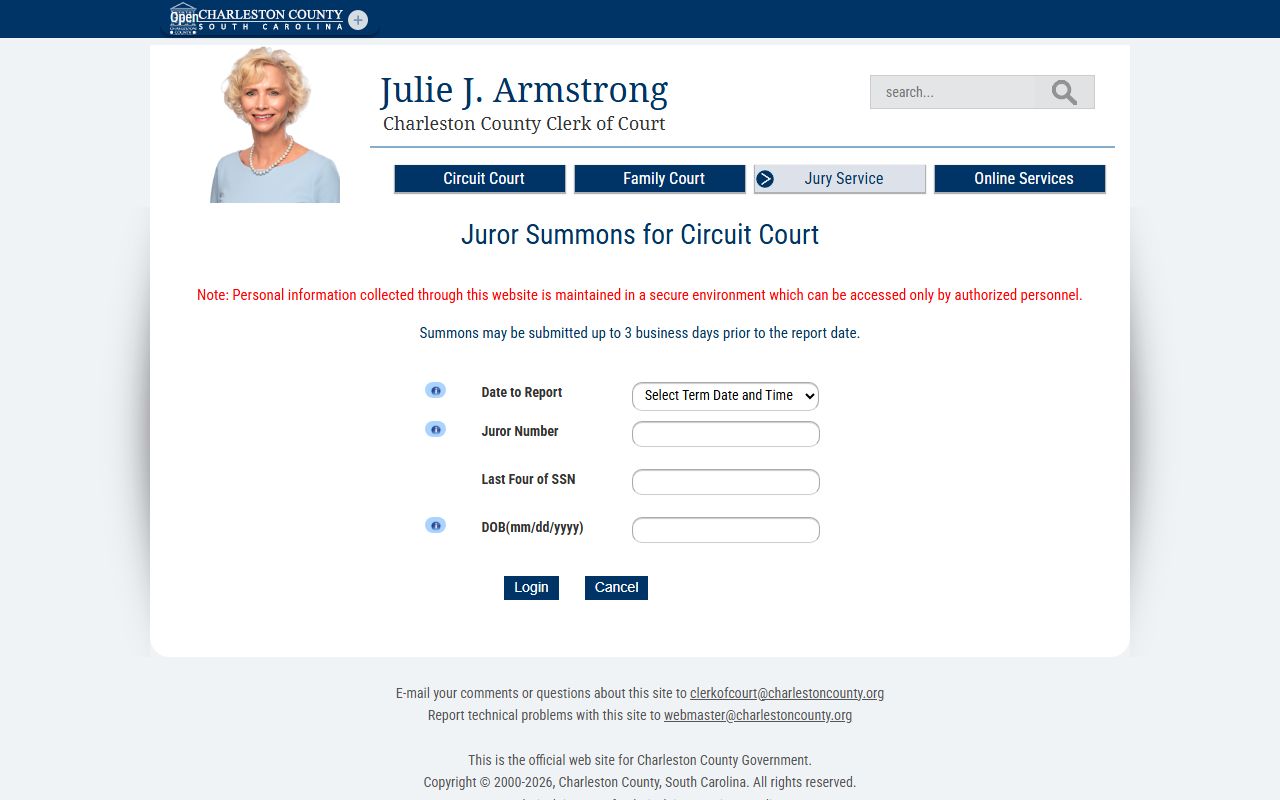
That portal at jurorsummons.charlestoncounty.gov lets jurors check their summons status and manage their response, and it reflects the Clerk of Court's role in running jury pools for Circuit Court trials.
Appeals and the South Carolina Appellate Courts
Once the Circuit Court issues a final judgment, the losing party can appeal. Most Circuit Court appeals go to the South Carolina Court of Appeals, which is the intermediate appellate court. Certain categories bypass the Court of Appeals and go directly to the South Carolina Supreme Court. Those include death-penalty cases, Public Service Commission rate decisions, constitutional challenges to legislation, and bonded-indebtedness matters.
A civil appeal from Common Pleas costs $150 to file with the Clerk. Criminal appeals from General Sessions carry no filing fee. The appeal record must be assembled from the Circuit Court file, and the Clerk's office plays a role in transmitting that record to the appellate courts. For cases involving a state-sentenced defendant, the South Carolina Department of Corrections becomes relevant after sentencing. Federal appeals from South Carolina go to the U.S. Court of Appeals for the Fourth Circuit in Richmond, Virginia, not to the state court system.
Common Pleas also hears first-level appeals from magistrate civil judgments, probate court orders, evictions, and some administrative agencies. That means Common Pleas serves as both a trial court and a lower appeals court in the same system. An appeal from a magistrate civil case to Common Pleas costs $150 to file.
For frequently asked questions about the court system, including how to read a disposition, what "nol prossed" means, and how to find an old case, see the FAQ page.
Charleston County Courthouse Location and Contacts
The main courthouse for Circuit Court and Family Court business is the Charleston County Judicial Center at 100 Broad Street in downtown Charleston. The Clerk of Court's Circuit Court counter is in Suite 106, and Family Court is in Suite 143. Both offices keep Monday through Friday hours from 8:30 a.m. to 5 p.m., closed on county holidays.
100 Broad Street, Suite 106
Charleston, SC 29401-2258
Phone: (843) 958-5000
Fax: (843) 958-5020
Hours: Monday-Friday, 8:30 a.m.-5 p.m.
Email: clerkofcourt@charlestoncounty.org
100 Broad Street, Suite 143
Charleston, SC 29401-2265
Phone: (843) 958-4400
Fax: (843) 958-4434
Hours: Monday-Friday, 8:30 a.m.-5 p.m.
4045 Bridge View Drive, Suite B-143
North Charleston, SC 29405
Phone: (843) 202-6600
Fax: (843) 202-6604
Hours: Monday-Friday, 8:30 a.m.-5 p.m.
Bond hearings and preliminary hearings are not held at 100 Broad Street. Those proceedings take place at 3831 Leeds Avenue in North Charleston. The detention center and warrants office are also on Leeds Avenue. Court visitors should plan separate trips for Broad Street court filings and Leeds Avenue bond or detention business. Downtown Charleston has limited parking; plan extra time before any hearing.
Self-represented litigants are held to the same standards as attorneys in South Carolina courts. The Clerk cannot give legal advice or prepare filings. For legal help, the South Carolina Legal Services portal at lawhelp.org/sc lists civil legal aid resources, and the South Carolina Bar's public referral page can connect you with an attorney. The Charleston County Public Defender serves defendants who cannot afford counsel in General Sessions cases.