
Charleston County Arrest Records Overview
An arrest record is a document produced at booking. When the Charleston County Sheriff's Office or a city police department takes a person into custody, the agency records the person's identifying information, the charges involved, the date and time of arrest, and the location. That booking record is the foundation of what most people call an "arrest record." It is not a court judgment. It does not mean the person was convicted. The notice on the county's inmate search portal puts it plainly: all inmates are innocent until proven guilty in a court of law.
Arrest records and criminal court records are related but not the same thing. An arrest record sits with the Sheriff's Office or police agency that made the booking. A criminal court record starts when charges are formally filed with the Clerk of Court and the case moves through General Sessions or a magistrate or municipal court. For full case history, including dispositions and sentences, the court records page covers the Public Index and the Clerk of Court's files. Arrest records cover what happened at booking, and that is the focus here.
Charleston County is large and busy. The Sheriff's Office describes itself as one of the largest full-service sheriff's offices in South Carolina. Bookings happen at the Sheriff Al Cannon Detention Center on Leeds Avenue in North Charleston. Sheriff Carl Ritchie, elected in November 2024, leads the agency. Not every booking leads to formal charges, and not every charge leads to a conviction.
How to Search Charleston County Arrest Records
The primary tool for finding Charleston County arrest records is the county's online inmate search portal at inmatesearch.charlestoncounty.gov. The portal covers current inmates and, when you check the "Show Past Bookings" box, people who were booked and later released. It asks for a reCAPTCHA verification before returning results. The Sheriff's Office has also delayed posting some booking data online to protect families from bail scams, so very recent bookings may not appear immediately.
- Go to inmatesearch.charlestoncounty.gov and complete the reCAPTCHA.
- Enter the last name. Add the first name to narrow results.
- Use the booking-date or arrest-date fields if you know the approximate time frame.
- Check "Show Past Bookings" to include people no longer in custody.
- Review results and click a record to see charges, inmate number, and booking details.
- For certified or official documentation, contact the Sheriff's Records division at 3505 Pinehaven Drive, North Charleston, SC 29405.
The county's inmate search also links to the South Carolina Judicial Branch case search page, which can help you move from an arrest record to the court file once charges have been formally filed. For active warrants tied to an arrest, see Charleston County warrant records.
The Clerk of Court FAQ page explains what happens after an arrest reaches the court system, including how criminal warrants are received and sent to the solicitor.
The Charleston County Clerk of Court FAQ describes how criminal warrants and court filings are handled once an arrest enters the formal court process.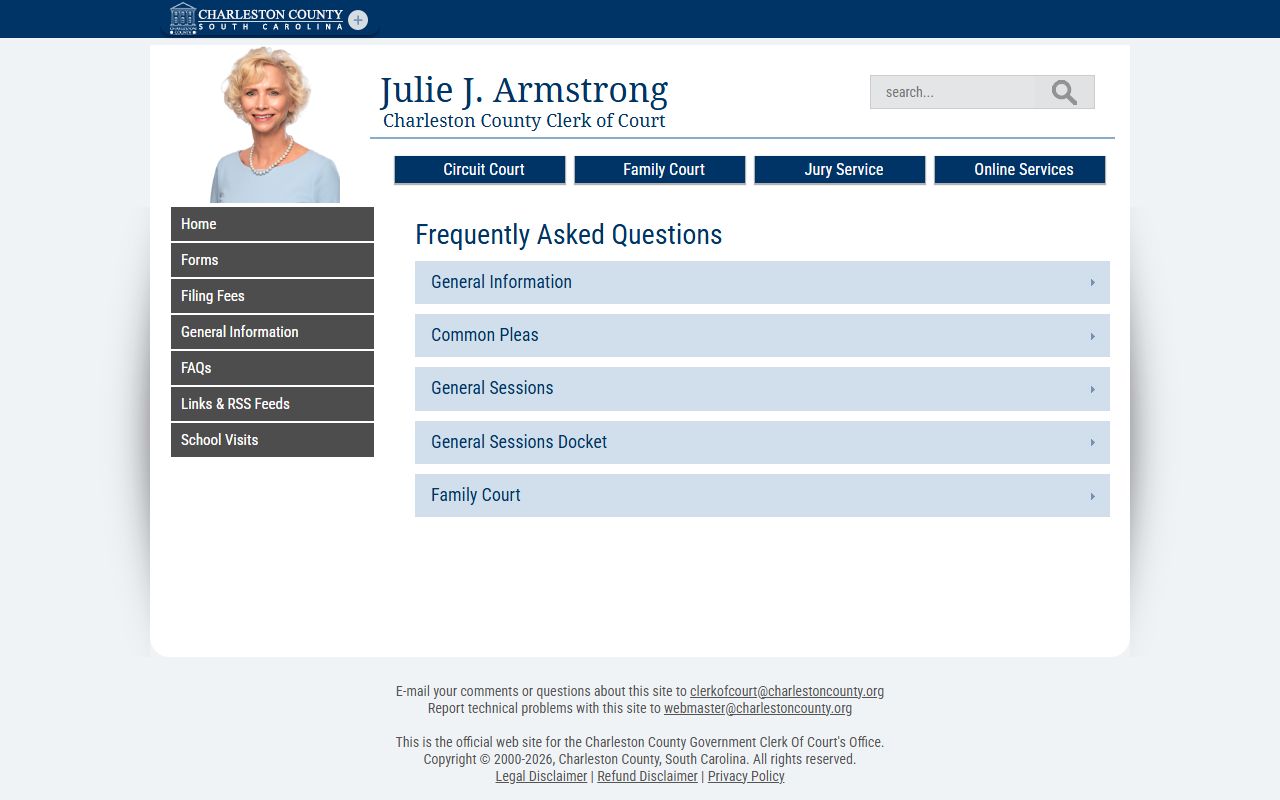
That page from the Clerk's office shows the steps that follow booking, including how the Clerk receives criminal warrants and transmits them to the Ninth Circuit Solicitor.
Arrest Records vs. Criminal Court Records in Charleston County
People often use "arrest records" and "criminal records" as if they mean the same thing. They do not. An arrest record is made at the Sheriff's Office or police agency when a person is booked. A criminal court record is created when the case moves into the court system, charges are filed, and the matter is tracked by the Clerk of Court. The two sets of records can cover the same person and the same incident, but they live in different places and contain different information.
In Charleston County, the Clerk of Court holds General Sessions criminal court records for felony cases at the Judicial Center, 100 Broad Street. Lower-level criminal records, such as misdemeanors and traffic offenses, sit with Summary Court Administration or the relevant municipal court. Arrest records stay with the booking agency, usually the Sheriff's Office. When a charge is dropped before court, the arrest record may still exist even though no court file was opened or the court file shows a dismissal. That gap matters if someone is trying to clear their record.
| Arrest Record | Criminal Court Record | |
|---|---|---|
| Source | Sheriff's Office or police agency | Clerk of Court |
| Created when | At booking / intake | When charges are formally filed |
| Contents | Name, booking date, charges at time of arrest, booking photo | Warrants, pleadings, motions, disposition, sentence |
| Search tool | Inmate search portal | Charleston County Public Index |
| May exist without the other | Yes, if charges are dropped pre-filing | Yes, if arrest leads to court but no conviction |
Note: For full case history after charges are filed, use the court records page, which walks through the Public Index and Clerk of Court access steps.
Charges vs. Convictions in Charleston County
A charge is the formal accusation. A conviction is a finding or plea of guilt. These are two different legal stages, and many arrest records show charges that never became convictions. The State only needs probable cause to charge someone. To convict, the burden is proof beyond a reasonable doubt. That is a much higher bar. A charge on an arrest record does not prove guilt, and arrest records should be read with that in mind.
In Charleston County, felony charges go through General Sessions after a preliminary stage. The Ninth Circuit Solicitor, Scarlett A. Wilson, decides which charges to prosecute and how. A charge marked "nol prossed" on a court file means the Solicitor chose not to continue the case. Dismissed means the court ended the matter. Neither outcome is a conviction. Magistrate and municipal courts handle lower-level charges, and a guilty plea or finding at that level is a conviction, just at a lower court level.
| Charge | Conviction | |
|---|---|---|
| Stage | Accusation at arrest or filing | Verdict or guilty plea |
| Burden of proof | Probable cause | Beyond a reasonable doubt |
| Shows on arrest record | Yes | Not automatically |
| Shows on criminal court record | Yes, as a charge filed | Yes, as final disposition |
| Stays on record if expunged | Removed from public access | Convictions generally not expungeable |
Mugshots and Booking Photos in Charleston County
Booking photos, often called mugshots, are taken at intake when a person is processed into the Sheriff Al Cannon Detention Center. They are part of the arrest record and are generally public under South Carolina law. The county's inmate search portal may display booking photos as part of an inmate record, though access to specific photo fields depends on whether the record is current or past.
South Carolina does not have a specific mugshot privacy law that automatically removes booking photos from public view. That means a photo may remain online even if charges are dismissed or the person is found not guilty. The Public Index notice for court records does allow removal of certain personal identifiers such as Social Security numbers and driver's license numbers from publicly posted records, but booking photos are not covered by that removal process. Someone who wants their photo removed from unofficial websites will likely need to contact those sites directly; that is outside the county's control.
For victims and others who need to verify whether a specific person is in custody, the Charleston County inmate records page covers the full inmate search process, including how to use the county portal and what data fields appear.
Note: The county inmate search portal carries the reminder that all inmates are innocent until proven guilty. A booking photo is not evidence of guilt.
Which Courts Handle Charleston County Criminal Cases
After an arrest, the case type determines which court takes over. General Sessions handles felony and serious criminal prosecutions in Charleston County. It is part of the Circuit Court and sits inside the Ninth Judicial Circuit, which covers Charleston and Berkeley Counties. The Clerk of Court at the Judicial Center, 100 Broad Street, holds General Sessions records. Magistrate courts handle lower-level offenses, traffic matters, and bond hearings. There are 19 magistrates spread across the county. Municipal courts cover city ordinance and traffic cases for residents of incorporated cities.
Bond hearings happen at the Centralized Bond Hearing Court, 3831 Leeds Avenue, Suite 200, North Charleston. Hearings run three times daily on weekdays at 10 AM, 2 PM, and 6 PM, and twice on weekends at 10 AM and 2 PM. A defendant does not enter a plea at a bond proceeding. That happens later in the formal court process.
The Charleston County Magistrates/Summary Courts page shows how these lower courts handle criminal and civil matters across the county.
The Magistrate civil court page explains the range of matters handled at the summary court level, from small claims to non-family restraining orders.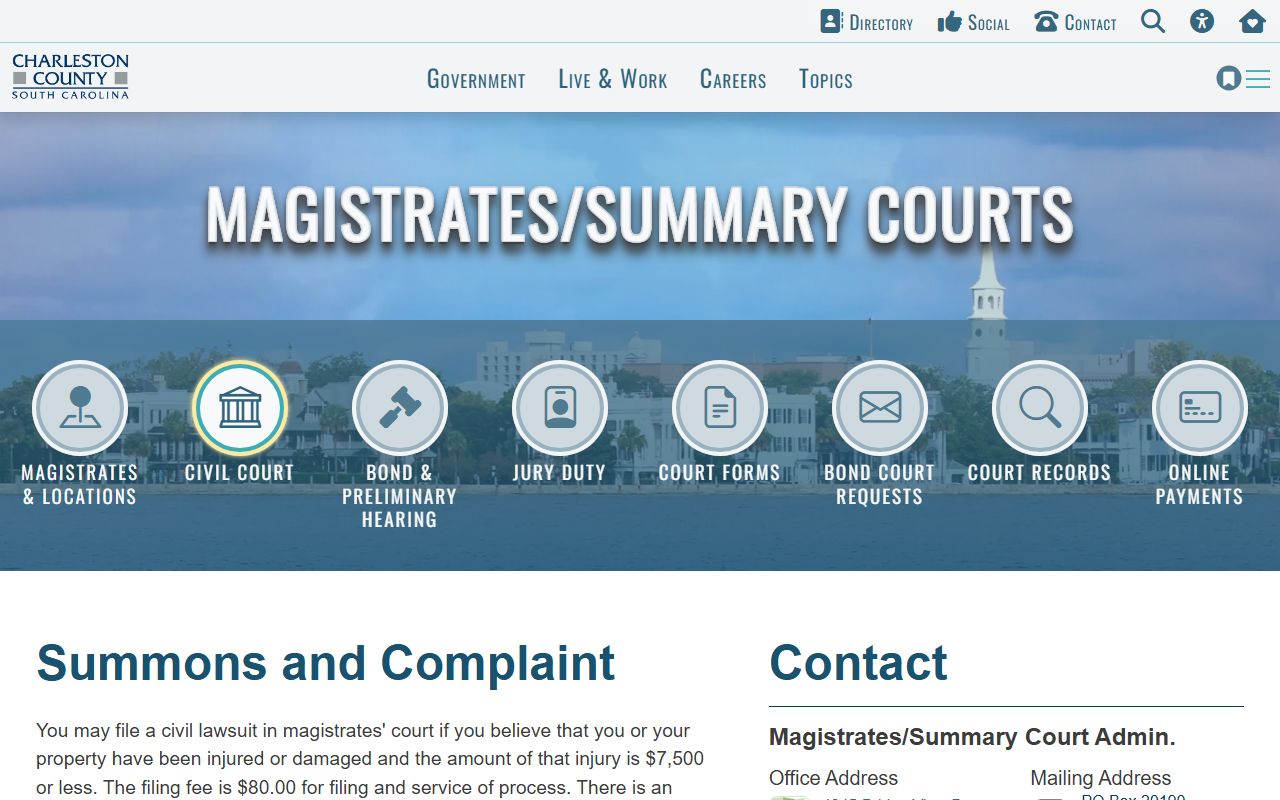
That page from the county's magistrate section outlines the civil reach of summary courts, which operate alongside the criminal side of magistrate practice where most initial arrest appearances happen.
Public vs. Restricted Charleston County Arrest Records
Most adult arrest records in Charleston County are public. The inmate search portal, the Public Index for criminal court files, and the warrants search are all open to the public without an account. South Carolina's Freedom of Information Act under S.C. Code Title 30, Chapter 4 gives the public a right to inspect and copy public records, and most adult arrest and court records fall under that framework. There are fees for copies, retrieval, and certified documents, but looking is generally free.
Juvenile records are a different story. Family Court juvenile matters are restricted by statute. Juvenile arrest records are not open to general public search. Expunging a juvenile record requires a separate process involving the Ninth Circuit Solicitor, the Department of Juvenile Justice, and the State Law Enforcement Division. Law-enforcement investigative records may also be withheld under FOIA exemptions that protect ongoing investigations, confidential sources, and certain personal privacy interests. Adoption records, mental-health commitments, and sealed records are closed to the public.
The FOIA exemptions matter for arrest records too. If the Sheriff's Office is still investigating a matter and releasing arrest detail would harm the investigation, that material can be withheld. Routine booking records for processed inmates are generally public once the booking is complete. Victims who need release notification should use the VINE service rather than the public search portal.
Sealed vs. Expunged Records in Charleston County
Sealing and expungement are two different legal outcomes, and South Carolina treats them differently. A sealed record is restricted from public view but may still exist in law-enforcement and court systems for certain purposes. An expunged record is treated as if it never existed for most purposes. After expungement, the arrest record and court file are removed from public access under the order that granted it, and a person can generally deny the arrest occurred. South Carolina's expungement statute at S.C. Code § 17-22-910 governs which records qualify and what the process requires.
| Sealed Record | Expunged Record | |
|---|---|---|
| Public visibility | Hidden from public access | Removed from public access; treated as never existed |
| Law enforcement access | Limited but may still exist internally | Very limited; subject to specific statutory rules |
| South Carolina eligibility | Court order required under Rule 41.1 or statute | Must qualify under § 17-22-910 or other specific statutes |
| Common scenario | Ongoing cases, juvenile files, certain sensitive records | Dismissed charges, not-guilty verdicts, first-offense conditional discharge |
| Who decides | Judge or court rule | Ninth Circuit Solicitor reviews eligibility; clerk processes order |
The South Carolina statehouse page for the expungement code explains the full statutory framework for qualifying offenses and procedures.
South Carolina Code § 17-22-910 sets out the expungement rules that the Ninth Circuit Solicitor applies when reviewing a Charleston County arrest record for removal.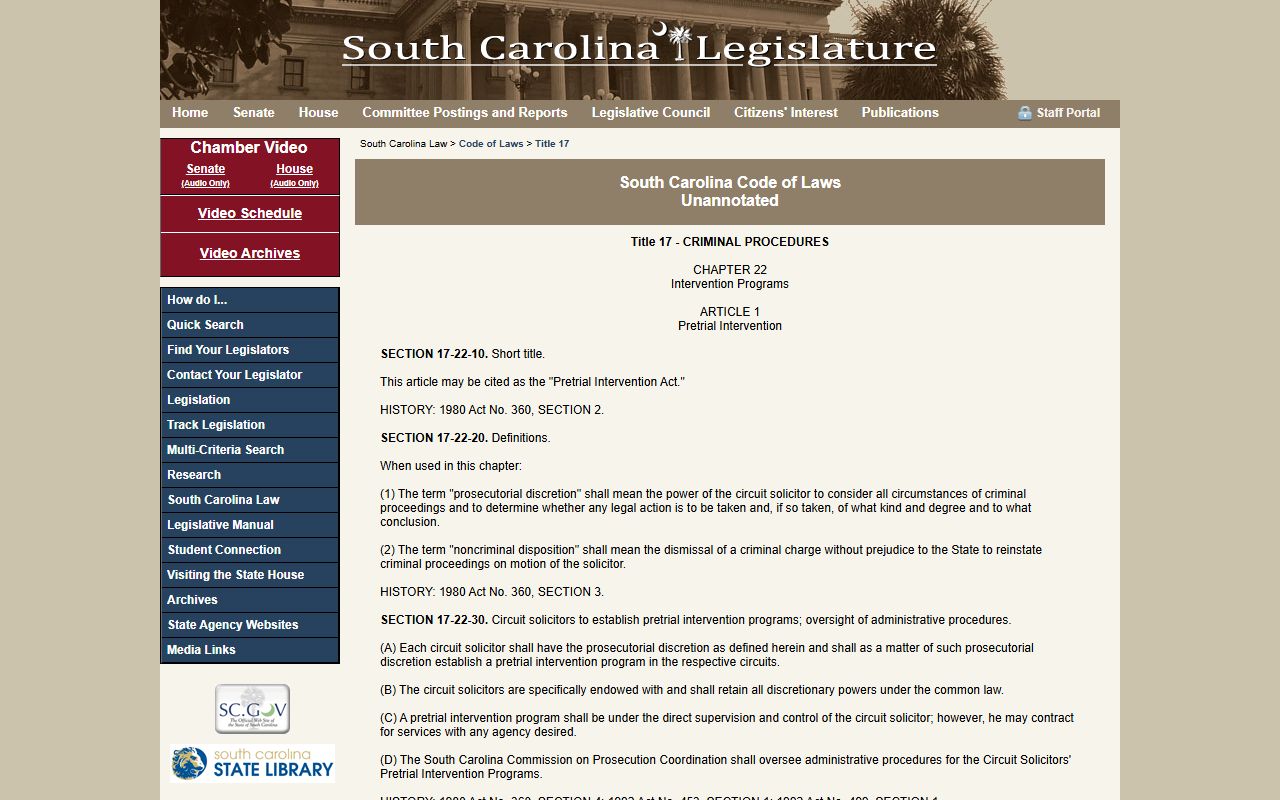
That page from the South Carolina General Assembly site shows the full text of the expungement statute, which is the legal foundation the Solicitor uses to decide whether a Charleston County arrest record qualifies for removal.
The Expungement Path in Charleston County
Getting a Charleston County arrest record expunged requires following a specific local process. It does not happen automatically when charges are dropped. The person whose record is at issue must take active steps through several offices in a set order. The Sheriff's Office FAQ lays out the path clearly for people arrested by the Charleston County Sheriff's Office.
- Get the disposition document from Sheriff's Records at 3505 Pinehaven Drive, North Charleston, SC 29405. This document shows the outcome of the arrest, such as dismissal, nol prossed, or not guilty.
- Take the disposition to the Ninth Circuit Solicitor's Office at the O.T. Wallace County Office Building, 101 Meeting Street, Charleston, SC 29401, phone (843) 958-1900. Office hours are Monday through Friday, 9:00 AM to 5:00 PM.
- The Solicitor reviews whether the arrest qualifies under South Carolina's expungement statutes. Not every dismissed case qualifies; prior record, offense type, unpaid fines, or statutory waiting periods can disqualify a record.
- If approved, the Clerk of Court processes the order. The Clerk charges $35.00 for expungements involving dismissed, nol prossed, or not-guilty outcomes.
- Once the order is entered, the arrest record is removed from public access at the Sheriff's Office and the court record is pulled from the Public Index.
First-offense conditional discharge for simple possession of marijuana is one qualifying path under S.C. Code § 44-53-450(b), as noted in the Charleston Magistrate FAQ. Other summary-court first-offense dispositions may also qualify under specific statutes. Juvenile expungements follow a longer process that includes the Department of Juvenile Justice and the State Law Enforcement Division. Convictions are generally not expungeable under South Carolina law.
Sheriff's Records (disposition documents)
3505 Pinehaven Drive
North Charleston, SC 29405
(843) 529-7300
Ninth Circuit Solicitor's Office
O.T. Wallace County Office Building
101 Meeting Street
Charleston, SC 29401
(843) 958-1900
Mon-Fri 9:00 AM-5:00 PM
Victim Notification and VINE in Charleston County
The Sheriff Al Cannon Detention Center uses the VINE system, also called SAVIN in South Carolina, to notify victims when an inmate is released, transferred, or escapes. Under S.C. Code § 16-3-1530, agencies with custody must make a reasonable effort to notify requesting victims of these events. VINE handles that notification automatically once a victim registers.
To register, call (866) 727-2846 or visit savin.sc.gov or VINELink. You choose a phone number and a four-digit PIN. When the system detects a change in custody status, it calls you. If you do not answer or an answering machine picks up, it keeps calling for up to 24 hours. The service is free and confidential. You can register more than one phone number. Victim advocates at the detention center can also help; reach them at (843) 529-7471 or the broader advocate lines at (843) 745-2250, (843) 745-2251, or (843) 745-2252.
Background Check Considerations for Charleston County Arrest Records
Charleston County arrest records that appear in the inmate search and the Public Index are public records. But there is a legal difference between a public-records search and a formal background check used for employment, housing, or credit decisions. The Fair Credit Reporting Act governs background checks used for those purposes and requires accuracy, dispute rights, and consumer protections. A casual search of the county inmate portal or the Public Index does not carry those protections.
For a formal employment or tenant background check, an employer or landlord typically uses a consumer reporting agency that is subject to the FCRA. Those agencies must follow federal rules about reporting arrest records that are older than seven years or that resulted in no conviction, depending on state law. South Carolina does not have a "ban the box" statute at the state level, so private employers have more latitude, but FCRA obligations still apply to the reporting agency. If a record was expunged, it should not appear on a proper FCRA background check, though unofficial databases may lag behind court orders.
Important: This website is not a consumer reporting agency under the FCRA. Records found here may not be used for employment, housing, credit, or insurance decisions.
Legal Help After a Charleston County Arrest
Anyone arrested in Charleston County and charged with a criminal offense has a right to legal counsel. If a person cannot afford an attorney, the court can appoint the Charleston County Public Defender's Office. The Public Defender is reached at (843) 958-1850. The office is described as a community-funded law firm and handles state criminal cases in the Ninth Judicial Circuit. There is no right to free legal assistance in civil proceedings.
Private attorney referrals are available through the South Carolina Lawyers Referral Service at (800) 868-2284. For civil legal matters, including expungement help or post-release questions, South Carolina Legal Services / LawHelp offers free and low-cost resources. The South Carolina Bar's public legal help page is another starting point. The Solicitor's Victim-Witness Unit at (843) 958-1900 can also connect victims with resources linked to a criminal case.
- Charleston County Public Defender - (843) 958-1850
- South Carolina Lawyers Referral Service - (800) 868-2284
- South Carolina Legal Services / LawHelp
- South Carolina Bar public legal help
- Solicitor Victim-Witness Unit - (843) 958-1900