
What Is a Court Docket in Charleston County
A court docket is a log. Every time something happens in a case, the clerk or the court's case-management system adds a line. That line notes the date, the type of event, and sometimes the party or attorney who triggered it. The full set of those lines is the docket. It shows a case's full timeline without giving you the actual text of the documents.
In Charleston County, the docket for a Circuit Court case lives inside the Public Index. When you open a case detail page in the Charleston County Public Index, you see the case header at the top and the event history below it. Civil cases in the Court of Common Pleas will show events like the filing of a complaint, answers, motions, orders, hearings, and the final judgment. Criminal cases in the Court of General Sessions show a different sequence: the warrant or indictment, the bond setting, any preliminary steps, a plea or trial, and the sentence or disposition.
The docket is not the same as the underlying documents. You may see an entry that says "Motion for Summary Judgment filed" without being able to open and read the motion itself. Document images in the Public Index vary by case and court. Some are posted online; others need a Clerk copy request. The docket entry just confirms the event occurred and when.
Dockets also differ from full case records in terms of depth. A full case file includes all the papers, exhibits, transcripts, orders, financial records, and other materials filed or issued in a case. The docket is the index to that file. Think of it as a table of contents. If you need more than the timeline, you will need the full file or specific documents from the Clerk.
How to Search Charleston County Court Dockets Online
The Charleston County Public Index is the main online tool for Circuit Court docket searches. It covers both Common Pleas civil cases and General Sessions criminal cases. The South Carolina Judicial Branch case search page also links to this county index and to trial-court portals across the state. Both are free and open without an account.
Before you search, gather the full party name and the approximate year the case was filed. A case number search is faster and cleaner. Name searches work, but spellings vary and some defendants use aliases. The Public Index search instructions warn that the tool blocks automated scraping, so plan to search one case at a time and review each result manually.
- Go to the Charleston County Public Index or the South Carolina Judicial Branch case search page.
- Select the correct court agency from the dropdown: Common Pleas for civil matters, General Sessions for serious criminal cases, or Magistrate for traffic and lower-level offenses.
- Enter a case number if you have one. If not, enter the party's last name and first name to pull a results list.
- Review the list for case number, party names, court agency, filing date, and status or disposition.
- Click the case to open the detail view, then scroll to the event or docket section to read the timeline of actions.
- Contact the Clerk of Court at 100 Broad Street, Suite 106, for any document copies or certified records you need after reviewing the docket.
The fee schedule for copies sits on the Clerk's filing-fees page. The Clerk charges $0.11 per copy page, $4.00 per record for retrieval, and $10.00 for a certificate under seal. Online review of a docket is free.
The Clerk's fee schedule page is the best starting point for understanding copy costs before you go in person.
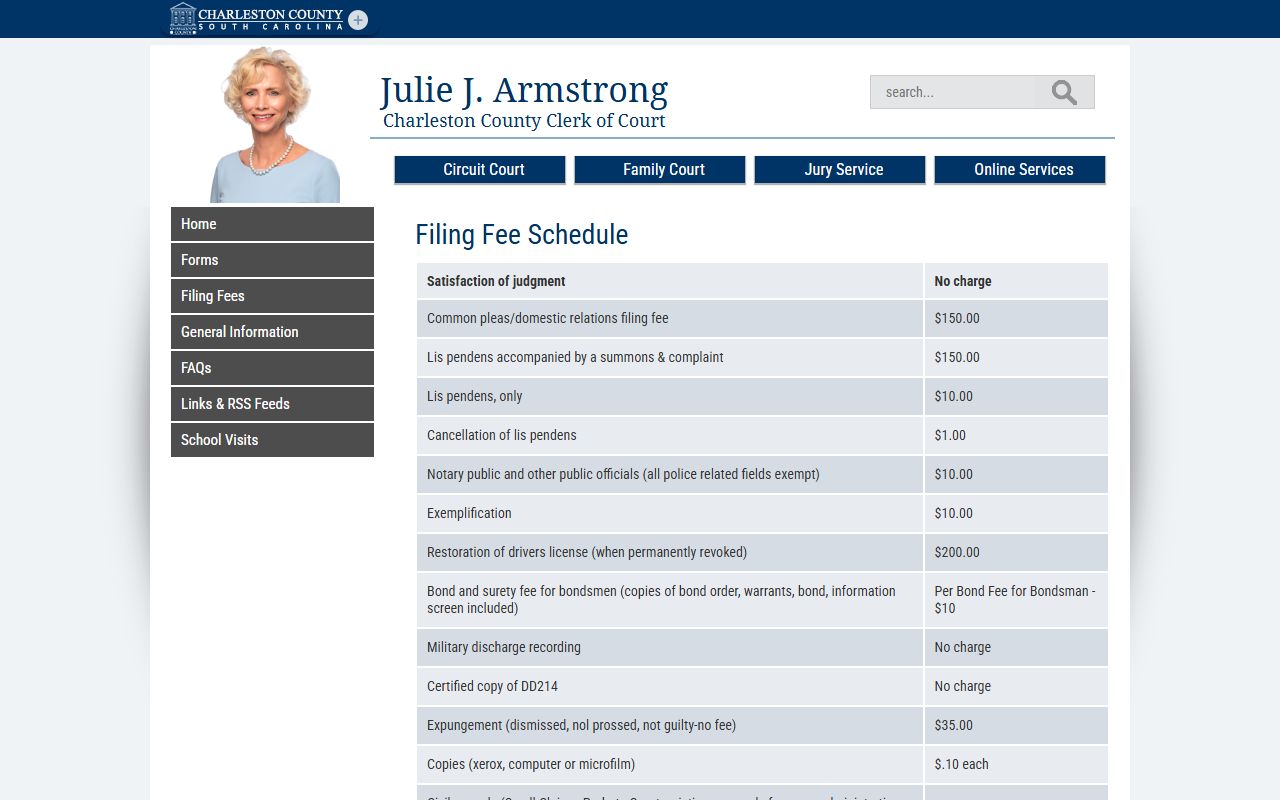
That schedule shows the full range of copy, retrieval, and certification charges that apply when you need physical documents beyond the docket view.
What a Charleston County Docket Entry Shows
Each line in the docket represents one event. The fields you see depend on the court and the case type, but most entries share the same basic structure. Civil and criminal cases both show date, event type, and party information. Criminal dockets may also show bond amounts, charge codes, and sentencing data. The table below maps the common fields to plain-language descriptions based on the Public Index case detail layout.
| Field | What It Shows |
|---|---|
| Entry Date | The date the event was recorded in the court's case-management system. |
| Event Type | The category of action: filing, motion, order, hearing, continuance, bond, plea, judgment, or disposition. |
| Party Filing | Which party or attorney triggered the event, such as plaintiff, defendant, State, or the court itself. |
| Document Link | A link to an image of the document if the court has posted it online; otherwise, the entry notes the event without an attached image. |
| Hearing Date / Time | For hearing entries, the scheduled date, time, and courtroom or judge may appear here. |
| Disposition Code | For final entries, a short code or phrase showing the outcome: dismissed, nol prossed, judgment, plea, sentenced, or transferred. |
| Financial Data | Fees, fines, court costs, restitution amounts, or bond amounts tied to the event where the court records them. |
Not every field appears in every entry. A simple continuance entry may show only a date and an event label. A sentencing entry may show the charge, the plea, the sentence length, and the financial obligations. Reading a docket well means knowing which event types carry the most data.
Courts That Publish Dockets in Charleston County
Charleston County is part of the Ninth Judicial Circuit, which it shares with Berkeley County. The courts inside the county range from the Circuit Court at the top of the trial-court level down through summary courts. Each court handles its own records, and online docket access is not uniform across all of them.
Here is how docket access breaks down by court in Charleston County.
- Court of Common Pleas - Civil division of the Circuit Court. Dockets for active and closed Common Pleas cases are searchable through the Public Index by case number or party name.
- Court of General Sessions - Criminal division of the Circuit Court. General Sessions dockets are also in the Public Index and show the full criminal event history from warrant to disposition.
- Family Court - Dockets for Family Court cases involve divorce, custody, support, and juvenile matters. Access is more restricted because cases involve minors and sensitive financial detail. The Clerk's menu references a captcha-protected Family Court search, but document-level access may require an in-person request.
- Magistrate Court - Magistrate dockets for traffic and small-claims cases may be accessible through the Public Index or by contacting Summary Court Administration at 4045 Bridge View Drive, North Charleston. Not all magistrate events appear in the online index.
- Probate Court - Probate dockets for estates, guardianships, and conservatorships are not part of the Circuit Court Public Index. Contact Probate Court or visit in person to check estate case status.
Note: Municipal Court records for city ordinance and traffic matters may not appear in the county Public Index; contact the relevant Municipal Court directly for those docket entries.
Bond and Preliminary Hearing Dockets in Charleston County
Bond hearings in Charleston County happen at the Centralized Bond Hearing Court on Leeds Avenue in North Charleston. These hearings take place multiple times each day: weekdays at 10 a.m., 2 p.m., and 6 p.m., and on weekends and holidays at 10 a.m. and 2 p.m. The bond court does not hold jury trials; it sets and reviews release conditions early in a case. Magistrates Amanda Haselden and Marcedes Smith preside at the bond court, located at 3831 Leeds Avenue, Suite 200.
Preliminary hearings are handled separately. The Centralized Preliminary Hearing Court operates at 3831 Leeds Avenue, Suite 100, under Chief Magistrate JoAnna Summey-Hayes. Preliminary hearings determine whether enough evidence exists to send a case forward to the Circuit Court. Bond entries and preliminary-hearing results become part of the docket when the case moves to General Sessions.
The Detention Center and bond information page shows the facility layout and the context for bond proceedings that feed into the docket record.
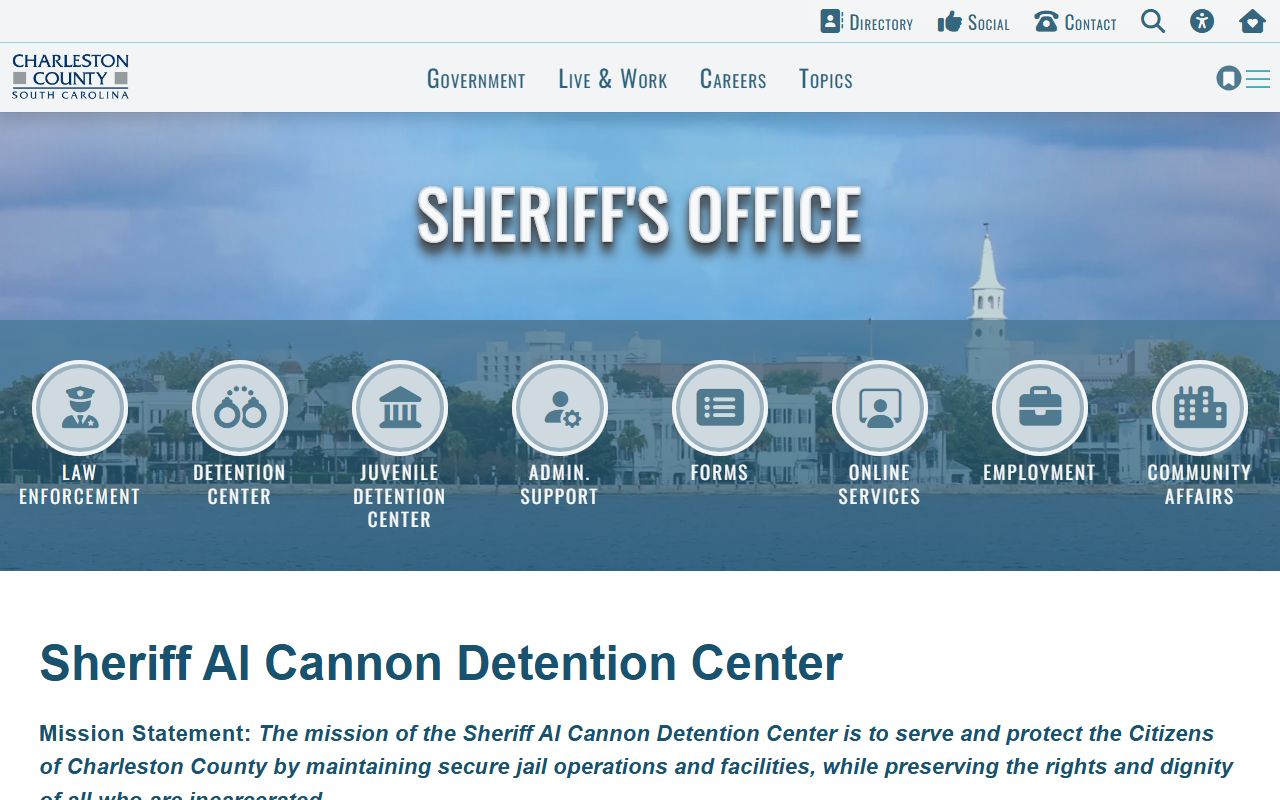
That page from the Charleston County Sheriff's Detention Center site explains the facility context behind the bond events you see in a criminal docket.
Docket vs. Full Case Record in Charleston County
People often use the terms "docket" and "case record" as if they mean the same thing. They do not. The docket is the log of events. The full case record includes every document filed or issued in the case: complaints, answers, motions, exhibits, transcripts, orders, and financial data. You may read the entire docket and still not know what a motion argued or what an order said unless you pull the actual document.
| Docket | Full Case Record | |
|---|---|---|
| Format | Chronological list of events | All filed documents and issued orders |
| Online access | Free via Public Index for most Circuit Court cases | Document images vary; some require Clerk copy or in-person visit |
| What you learn | What happened and when | What was argued, decided, or ruled in detail |
| Use case | Track case status, verify a charge or outcome, confirm a hearing date | Legal review, appeals prep, evidence research, certified copies for court |
| Cost | Free to view online | $0.11 per copy page; $4.00 retrieval; $10.00 certified seal |
For most people checking a status or verifying a final result, the docket is enough. Attorneys and self-represented parties preparing for a hearing usually need the full file. Certified copies are always required when you need to use a court record in another legal proceeding.
For more on the full record, see Charleston County court records and the Clerk of Court page for copy request details.
How to Read a Charleston County Docket
Docket entries use short codes and legal terms that can be hard to parse if you are not used to them. A few terms come up often in Charleston County Circuit Court dockets. Knowing them saves time and avoids misreading a case outcome.
- Disposition
- The final result of a charge or case. A disposition entry closes a matter. Examples: dismissed, nol prossed, guilty plea, not guilty verdict, judgment for plaintiff.
- Nol prossed
- Short for nolle prosequi. The solicitor chose not to continue a criminal charge. The case is dropped, but it is not the same as a not-guilty finding.
- Continuance
- A postponement of a hearing or trial date. A continuance entry just moves the schedule forward; the case stays open.
- Bench warrant
- A warrant issued by a judge, usually after a party failed to appear in court. A bench warrant entry in a docket means the court issued an order for arrest.
- Lis pendens
- A notice filed in a civil case that a lawsuit affects real property. Shows up in Common Pleas dockets for real estate disputes.
- Bond
- The release condition set in a criminal case. A bond entry may show the amount, whether it is cash, personal recognizance, or surety, and whether it was posted.
Dispositions in General Sessions cases can be read alongside the charge. If a charge is listed as nol prossed or dismissed, the person was not convicted on that count. If a charge shows a guilty plea or jury verdict, the person was convicted. A sentence entry will follow a conviction and list the punishment. Reading the disposition and the sentence together tells the full story of how a criminal case ended.
Civil dockets work differently. The final entry in a Common Pleas case might be a judgment for the plaintiff in a set dollar amount, a judgment for the defendant, a voluntary dismissal, or a settlement order. Continuances are common in civil cases too. A long civil docket with many continuance entries may indicate an active dispute or slow-moving litigation.
Older and Missing Charleston County Dockets
Not every Charleston County docket entry is online. The Public Index covers cases in the current case-management system, but older cases filed before the system was in use may not appear. If a search returns no result, the case may still exist in paper form at the Clerk's office or in archived storage.
For cases that are not in the Public Index, the best path is to contact the Charleston County Clerk of Court directly. The office is at 100 Broad Street, Suite 106, and is open Monday through Friday, 8:30 a.m. to 5 p.m. Staff can search the paper docket books or archived records and provide copies at the standard copy rate. Some older Circuit Court records have been microfilmed. Family Court records follow a separate path through Suite 143, phone (843) 958-4400.
Magistrate Court dockets for older traffic or small-claims cases may sit with Summary Court Administration at 4045 Bridge View Drive, Suite B-143, North Charleston, phone (843) 202-6600. Each magistrate location keeps its own files for matters it has heard, so contacting the right court first saves time.
For records related to criminal history rather than case status, the South Carolina Law Enforcement Division (SLED) maintains the state criminal-history repository. That is a separate database from the court docket system. The SLED sex offender registry page shows how another state database operates alongside but separate from the court Public Index.
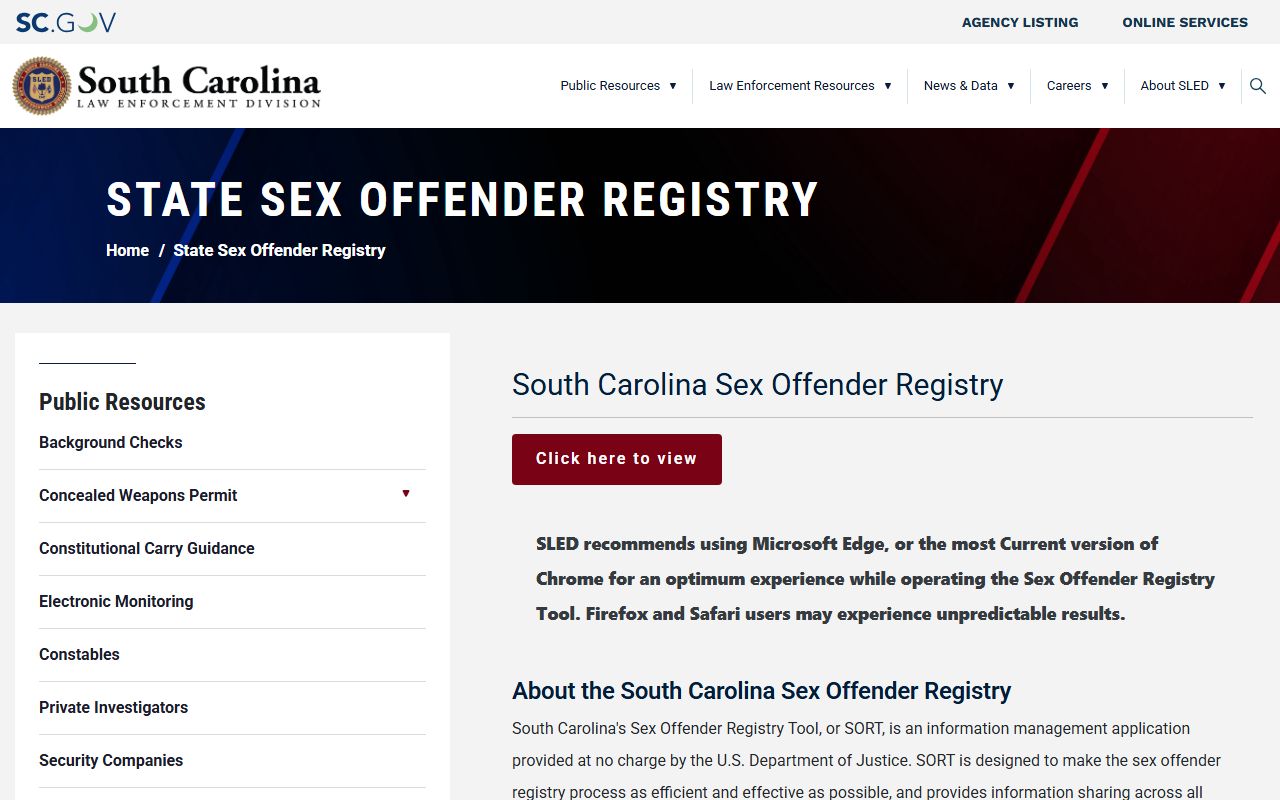
The SLED sex offender registry is an example of a state-maintained record system that runs parallel to court dockets and holds data not available through the county Public Index.
Docket Entries That May Be Restricted or Sealed
Most Circuit Court docket entries are public record, but some are closed or limited by law. Juvenile cases in Family Court are confidential. Adoption files are sealed. Domestic-abuse case details and the names of protected parties or minors may be withheld from the public docket. Mental-health commitment cases handled by Probate Court carry strong medical-privacy restrictions.
In Circuit Court, a judge can seal a record or a portion of a file. When that happens, the docket may show that a document was filed without showing its content, or the entry may be removed from public view entirely. South Carolina E-Filing Rule 10 requires filers to handle sensitive identifiers properly and provides for motions to seal. The result is that a docket may have gaps or redacted entries that the online view does not explain.
Personal identifiers can also be removed from publicly accessible internet copies on request. The Public Index carries a notice that Social Security numbers, driver's license numbers, state ID numbers, passport numbers, bank account numbers, credit and debit card numbers, PIN codes, and passwords can be removed from the public online record if a party submits the proper request. Those identifiers are not supposed to appear in a filed document under current e-filing rules, but older cases may have them in paper form.
Note: If a docket entry or case is missing from the Public Index and you believe it should be public, contact the Clerk of Court before assuming the record does not exist. Older cases, sealed records, and system-migration gaps can all cause a search to return no result.
Recording and Cameras Near Charleston County Docket Proceedings
Courts in Charleston County follow South Carolina Appellate Court Rule 605, which gives judges control over electronic and photographic media coverage in court facilities. A judge can allow or restrict cameras, audio equipment, and other recording devices in the courtroom. The rule applies to media and the general public alike.
If you attend a court proceeding to follow a case in the docket, do not assume you can record it. Check with the specific court or clerk's office ahead of time. Cell phones and cameras may need to stay off or out of sight. ADA accommodations and any special-access needs should also be arranged with the court in advance by contacting ADACoordinator@CharlestonCounty.org.
The Rule 605 page from the South Carolina courts explains when and how judges may exercise discretion over recording in South Carolina courtrooms.
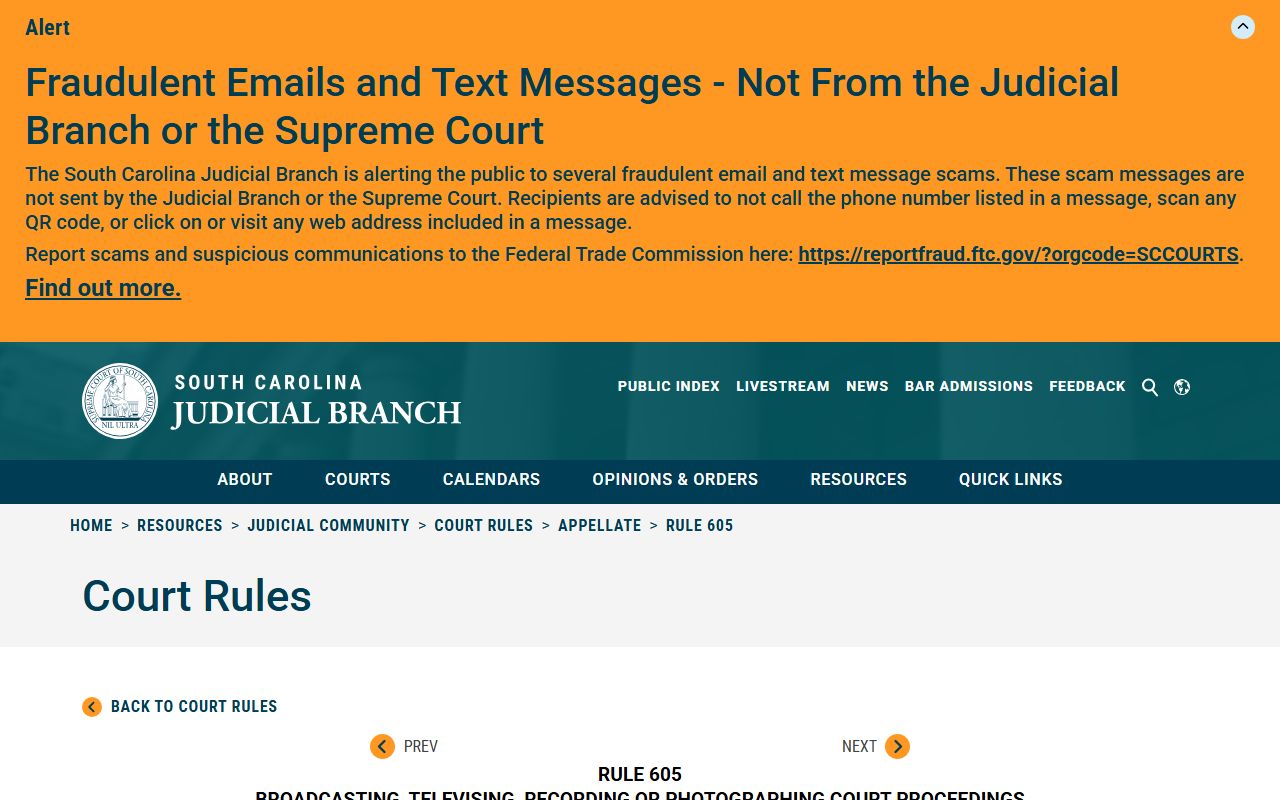
That page at sccourts.org sets out the statewide framework for camera access that applies to every hearing where a Charleston County docket entry is being made.
Court Dockets vs. Driver Records in Charleston County Traffic Cases
A traffic case in a Charleston County Magistrate or Municipal Court produces two separate records. The court docket shows what happened inside the case: the charge, the hearing date, any continuances, and the disposition. The state driver record is a different file kept by the South Carolina Department of Motor Vehicles. It tracks points, suspensions, license status, and the outcomes of traffic offenses as they affect driving privileges.
Reading a court docket will tell you whether a charge was dismissed, reduced, or resulted in a conviction. It will not tell you how many points a person now has or whether a license was suspended. For that, you need the driver record through the South Carolina DMV.
The SCDMV handles driver records and license status separately from the court system.
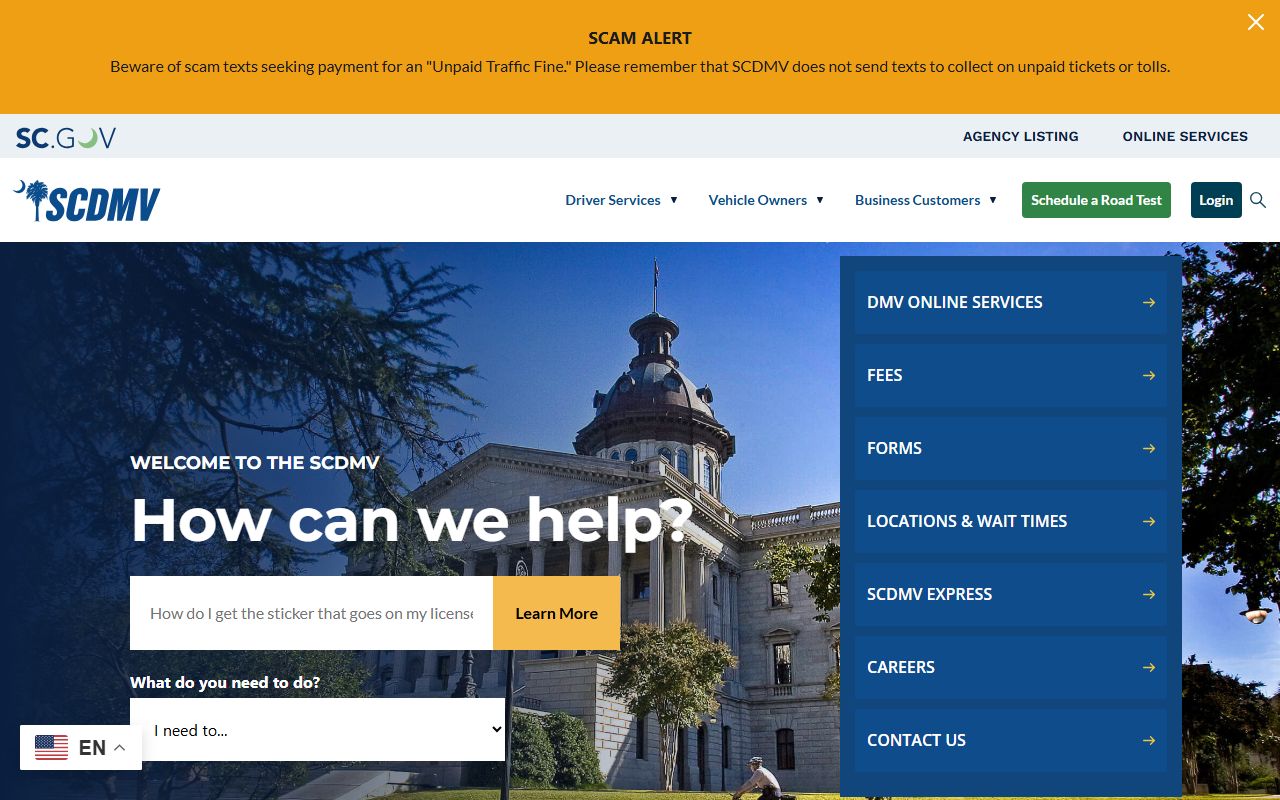
The South Carolina DMV site is where you look for the driver-side effects of a traffic case that the court docket alone does not capture.
Charleston County Court Docket Contacts
Different courts manage their own docket records. Knowing where to call or visit saves time. The offices below handle the main docket-related questions for Charleston County cases.
Charleston County Clerk of Court
100 Broad Street, Suite 106
Charleston, SC 29401
(843) 958-5000
Mon-Fri 8:30 a.m.-5 p.m.
Family Court (Suite 143)
100 Broad Street, Suite 143
Charleston, SC 29401
(843) 958-4400
Mon-Fri 8:30 a.m.-5 p.m.
Summary Court Administration
4045 Bridge View Drive, Suite B-143
North Charleston, SC 29405
(843) 202-6600
Mon-Fri 8:30 a.m.-5 p.m.
Centralized Bond Hearing Court
3831 Leeds Avenue, Suite 200
North Charleston, SC 29405
(843) 746-9822
Weekdays: 10 a.m., 2 p.m., 6 p.m.
Weekends/Holidays: 10 a.m., 2 p.m.