
How to Search Charleston County Traffic Court Records
The main free tool for searching Charleston County traffic court records is the Charleston County Public Index. The Public Index covers Magistrate Court and some Municipal Court traffic cases. You can reach it from the South Carolina Judicial Branch case-search page or directly at the county address. If you lost your ticket, the Magistrate FAQ says to contact Summary Court Administration at (843) 202-6600 or search the Public Index. If a city police officer issued the ticket, the right place to search is that city's Municipal Court, not the county index. Summary Court Administration does not have access to Municipal Court records.
Before you start, have the citation number from the ticket if possible. If you do not have the number, your full legal name and an approximate date will work. The portal allows searches by case number or by defendant name. A case number search is more exact because name searches can pull up multiple matches.
- Open the Charleston County Public Index at jcmsweb.charlestoncounty.gov/PublicIndex/.
- Select the correct court agency from the dropdown. Choose Magistrate or the relevant Municipal Court for traffic cases.
- Enter the case or citation number if you have it. If not, type the defendant's last name and first name.
- Add a date range to narrow the results when many cases share a similar name.
- Review the case list for your citation number, charge, and status. Open the case to see the full record.
- Contact the Clerk of Court or the relevant Magistrate Court to request a certified copy of the traffic case record.
Which Courts Handle Traffic Cases in Charleston County
Charleston County does not route all traffic tickets through one court. Which court holds your record depends on which police agency wrote the ticket. County sheriff and county-level officers generally send their tickets to Magistrate Court. City police tickets go to the Municipal Court for that city. Serious criminal traffic charges, like felony DUI or reckless homicide, start at the bond hearing level and may move to Circuit Court General Sessions.
There are several Magistrate Courts spread across Charleston County. Summary Court Administration at 4045 Bridge View Drive, Suite B-143, North Charleston, is the central administrative office. Individual courts serve different parts of the county, from downtown Charleston to Mount Pleasant, James Island, and McClellanville. Each court keeps its own records for cases in its jurisdiction. The Public Index pulls many of these records together, but always confirm with the specific court when you need a certified copy or have a filing deadline.
- Magistrate Courts (county-level) - Handle traffic tickets from the county sheriff and county-level agencies, misdemeanor traffic offenses, and bond hearings for traffic arrests. Contact Summary Court Administration at 4045 Bridge View Dr., Suite B-143, North Charleston, SC 29405, phone (843) 202-6600.
- Municipal Courts (city-level) - Handle tickets written by city police in Charleston, North Charleston, Mount Pleasant, Folly Beach, Isle of Palms, and other incorporated municipalities. Contact the specific city court listed on your ticket.
- Circuit Court / General Sessions - Handles felony DUI, reckless homicide, and other serious criminal traffic charges that go beyond summary-court limits. Contact the Clerk of Court at 100 Broad St., Suite 106, Charleston, SC 29401, phone (843) 958-5000.
Types of Traffic Cases on Record
Charleston County traffic cases cover a wide range of offenses. Most tickets fall into one of a few clear groups. Moving violations are the most common. They show up in case records with the charging statute or ordinance and a specific offense description. Non-moving violations like equipment failures or registration issues also generate records but rarely carry points. Understanding what type of case you are looking for helps you pick the right court and the right search fields in the Public Index.
- Moving violations - Speeding, running red lights, improper lane changes, reckless driving, and similar offenses that happen while the vehicle is in motion.
- Non-moving violations - Equipment defects, expired registration, window tint, and other violations that do not involve the motion of the vehicle.
- Misdemeanor traffic offenses - Driving under suspension, no insurance, and lower-level criminal traffic charges handled in Magistrate or Municipal Court.
- Commercial vehicle and CDL violations - Tickets involving commercial vehicles or drivers with a Commercial Driver License; federal and state reporting rules apply.
- Serious criminal traffic charges - Felony DUI, reckless homicide, and other charges that exceed summary-court limits and proceed to General Sessions.
The Magistrate traffic and criminal hearings page explains how bond proceedings and preliminary hearings work for traffic-related criminal arrests. If your case involved an arrest, it likely started at Centralized Bond Court on Leeds Avenue before moving to the appropriate trial court.
What Charleston County Traffic Court Records Show
A Charleston County traffic court record shows the details of the citation and everything that happened after it was filed. The court case file is different from your state driving record. The court file is the official record of the charge, the court proceedings, and the outcome. Driver's license numbers and personal identifiers such as Social Security numbers and dates of birth are redacted from public internet display under the Public Index privacy rules. What you will see in a public traffic case record includes the fields below.
| Field | What It Shows |
|---|---|
| Citation / Case Number | The unique identifier printed on the ticket; used to pull the exact case in the Public Index |
| Defendant Name and Address | The person cited; driver's license number is in the court file but is redacted from public internet display |
| Charging Statute or Ordinance | The specific law the officer cited, such as a South Carolina Code section or a municipal ordinance |
| Offense Date, Time, and Location | When and where the violation occurred |
| Officer and Issuing Agency | The officer's name and the law-enforcement agency that issued the ticket |
| Court Date, Time, and Location | The scheduled hearing and the court where it is set |
| Plea | Guilty, not guilty, or another response entered by the defendant |
| Disposition | The final result: guilty, not guilty, dismissed, nol prossed, paid, bond forfeiture, transferred, or appealed |
| Fine, Court Costs, and Payment Status | Dollar amounts owed and whether they have been paid |
| Failure to Appear / Bench Warrant Status | Whether the defendant missed a court date and whether a bench warrant was issued |
| License Suspension References | Notes that a court action may have triggered a DMV report or a suspension process |
Note: Juvenile traffic cases may be restricted from public view. If you are searching for a juvenile traffic record, contact the appropriate court directly to ask about access.
Searching by Citation Number vs by Name
The Public Index supports both citation number searches and name searches. A citation number search is more precise. It pulls the exact case without sifting through other people who share a last name. Name searches are useful when you do not have the citation number, but they can return multiple results, especially for common names in a large county like Charleston. If you search by name and get too many results, add a date range or select a specific court agency to narrow the list.
The search fields in the Charleston County Public Index for traffic cases match the general case-search layout. The table below shows what to expect when searching for a traffic citation.
| Search Field | Type | Required | Notes / Format |
|---|---|---|---|
| Case / Ticket Number | Text | No | Use the citation number printed on the ticket for the most direct result |
| Defendant Last Name | Text | No | Enter the last name as it appears on the ticket or license |
| Defendant First Name | Text | No | Optional; narrows name-based results |
| Court Agency | Dropdown | No | Select Magistrate or the specific Municipal Court where the case was filed |
| Date Range | Date | No | Filing date or citation date range; useful when searching by name |
| Search / Clear | Button | n/a | Runs the search or resets all fields |
Paying or Contesting a Charleston County Traffic Ticket
The ticket itself tells you the court, the court date, and the citation number. Read it carefully before doing anything else. Each court has its own payment and appearance process. Do not assume that paying online through the county works for every ticket. A ticket written by a city officer goes to that city's Municipal Court, not to Magistrate Court. Summary Court Administration handles county Magistrate tickets and says it does not have access to Municipal Court records.
For Magistrate Court tickets, South Carolina allows payment by money order or certified check made payable to the court. Many Magistrate tickets can also be paid online. Ignoring a traffic ticket is one of the more costly mistakes a driver can make. Failure to pay or appear can result in a bench warrant, license suspension by SCDMV, added court costs, and possible collection action. If you want to contest the charge, contact the court listed on the ticket before your court date to understand the process. CDL holders should get legal advice before paying or pleading, because paying a ticket counts as a conviction and can affect commercial driving privileges under federal rules.
- Read the ticket and identify the court name, court date, and citation number.
- If the ticket is from a county Magistrate Court, contact Summary Court Administration at (843) 202-6600 or search the Public Index. Pay by money order, certified check, or online where the court allows it.
- If the ticket is from a city police department, contact that city's Municipal Court directly. Summary Court Administration does not handle those records.
- If you lost the ticket, call Summary Court Administration or use the Public Index for county Magistrate tickets. For a municipal ticket, call the relevant Municipal Court.
- To contest the ticket, appear on the scheduled court date. Do not ignore the date or skip it without first contacting the court.
- If convicted, SCDMV may receive a report of the conviction and may assess points or take license action. Review your SCDMV driving record after the case closes to confirm what was reported.
- For serious criminal traffic charges, a bond hearing and possibly a preliminary hearing apply before any trial. These cases may move from Magistrate to Circuit Court General Sessions.
Public Access Laws for Traffic Court Records
Charleston County traffic court records are public records under South Carolina law. The main public-access framework for government records is the South Carolina Freedom of Information Act, Title 30, Chapter 4. However, most traffic court records are obtained directly from the court clerk or through the Public Index, not through a FOIA request. FOIA applies more to county administrative and law-enforcement records than to records that are already searchable through the court portal. If a court record is sealed or involves a juvenile, a FOIA request will not override those restrictions.
Two court rules shape how electronic access works. South Carolina Appellate Court Rule 610 limits bulk distribution and compiled data from court records for commercial purposes. This is why automated scraping of the Public Index is prohibited by the system's own notice. E-Filing Rule 10 requires that sensitive personal identifiers be kept off public case records. Under the Public Index privacy notice, you may request removal of your Social Security number, driver's license number, state ID, passport, bank account, or card numbers from publicly available internet copies of official records.
The screenshot below comes from the South Carolina statutes page that governs court fees, including S.C. Code § 8-21-770(B), which addresses fee structures tied to court records.
The South Carolina Statutes site at scstatehouse.gov publishes the official text of the laws that govern court fees and access in South Carolina.
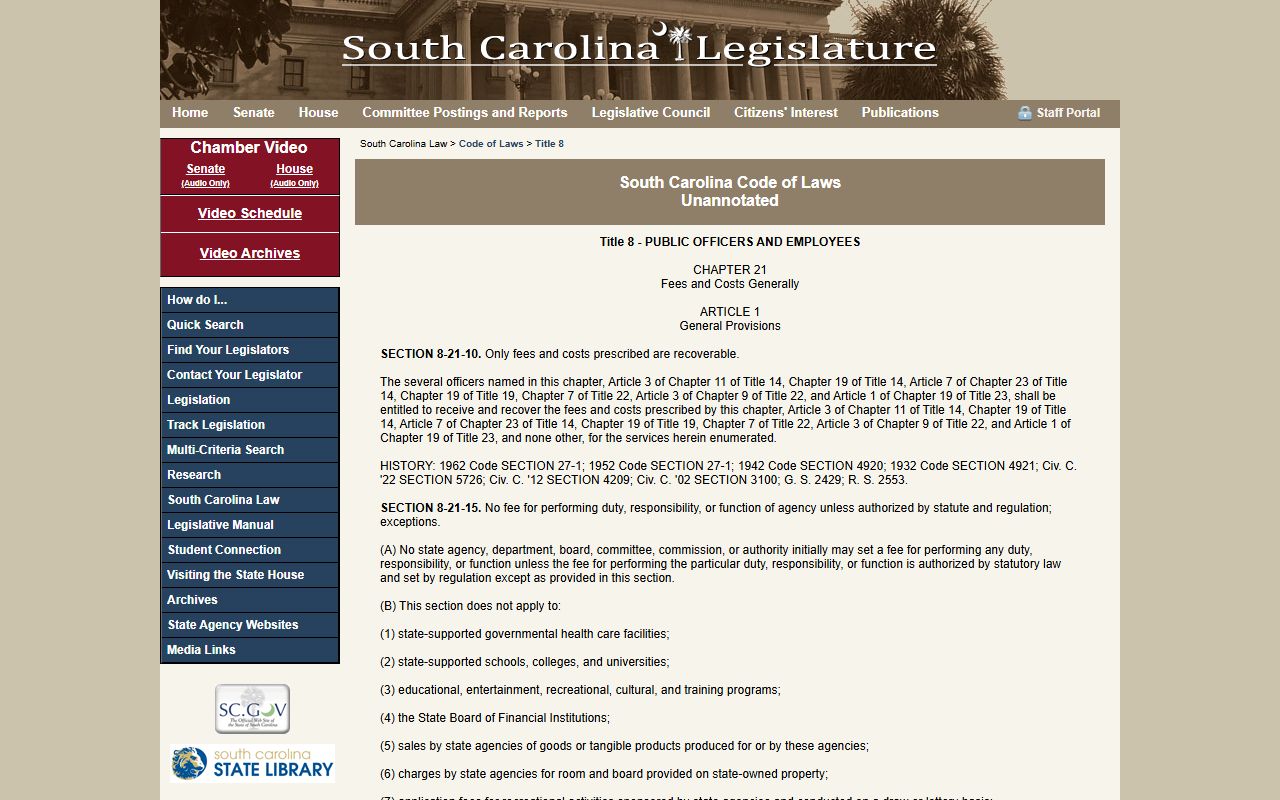
Fee and access statutes like § 8-21-770(B) set the legal basis for what courts can charge when they provide copies of Charleston County traffic court records and other official filings.
Court Traffic Records vs State Driver Records
Many people confuse the court traffic record with the state driving record. They are two separate files kept by two different agencies. The court traffic record lives with the Magistrate Court, Municipal Court, or Circuit Court that handled the case. It shows what happened in court: the charge, the plea, the fine, and the disposition. The state driver record lives with the South Carolina Department of Motor Vehicles. It shows what courts have reported as convictions, what points have been assessed, and what the current status of your license is. A court dismissal of a traffic ticket may not appear as a conviction on the driver record, but a paid ticket or a guilty plea will typically be reported to SCDMV and may result in points.
To get a copy of your South Carolina driving record, contact SCDMV directly. The SCDMV Form DL-107A is used for certain driver record requests, including National Driver Register information. The Driver Privacy Protection Act and South Carolina rules restrict access to another person's driver record; you generally cannot pull someone else's driving record without an authorized purpose.
| Record Type | Where It Comes From | What It Shows | How to Access |
|---|---|---|---|
| Court Traffic Record | Magistrate Court, Municipal Court, or Circuit Court / Charleston County Public Index | Citation number, charge, officer, court date, plea, disposition, fine and costs, FTA or bench warrant status, payment status | Free search via Public Index; certified copies from Clerk or relevant Magistrate / Municipal Court |
| State Driver Record | South Carolina DMV | License status, convictions reported by courts, points assessed, suspensions, revocations, CDL status, administrative DMV actions | Request from SCDMV; Form DL-107A for National Driver Register; subject to driver privacy rules |
The Charleston County Probate Court marriage license page, shown below, illustrates how the county's online portals are organized across different court functions, each handled separately from the traffic case system.
Just as the Probate Court keeps marriage records separate from Circuit Court, traffic records at the Magistrate level are separate from your SCDMV driver record and from Circuit Court General Sessions files.
CDL and Commercial Driver Records
Commercial Driver License holders face stricter rules than ordinary drivers when it comes to traffic violations. Federal law and South Carolina rules require courts to report CDL-related convictions to SCDMV, which then reports them to the federal Commercial Driver License Information System. A CDL holder convicted of a serious traffic violation in a personal vehicle is still subject to CDL consequences. Paying a traffic ticket without appearing in court counts as a guilty plea and triggers the reporting process. Deferred adjudication and plea-based dismissals that might help ordinary drivers often are not available to CDL holders for certain offenses under federal guidelines. CDL holders should get legal advice before entering any plea or paying any ticket. The stakes are higher because even a first offense can lead to a CDL disqualification period that ends a commercial driving career.
For questions about CDL status and suspension after a traffic conviction, contact SCDMV directly. The court handles the criminal or traffic case; SCDMV handles the license status and the CDL record. Those are two separate processes running at the same time.
DUI / DWI Cases
A DUI or DWI charge in Charleston County is a criminal matter, not a simple traffic ticket. First-offense misdemeanor DUI cases may be heard in Magistrate or Municipal Court, but charges that carry higher penalties move to Circuit Court General Sessions. Serious charges like felony DUI or reckless homicide start at Centralized Bond Court on Leeds Avenue. The case may then go through a preliminary hearing before a magistrate and eventually proceed to General Sessions before the Ninth Circuit Solicitor.
For full details on Charleston County DUI and criminal traffic cases, see Charleston County criminal records.
Deferred Adjudication and Defensive Driving Course
South Carolina Magistrate Courts have the ability in some cases to allow a defendant to complete a program or meet conditions before a final ruling is entered. The Charleston Magistrate FAQ references specific statutory paths for first-offense situations. For example, S.C. Code § 44-53-450(b) provides a conditional discharge process for a first offense of simple possession of certain substances; after completion, the charge may be eligible for expungement. Similar limited-offense pathways may apply to some first-time minor traffic-related matters in summary court, but they are not available for all violations and are not the same as the kind of deferred adjudication programs used in some other states.
Defensive driving course completion is referenced by some traffic dispositions. In general, a driver who completes an approved defensive driving course in South Carolina may have points reduced on their SCDMV record, but the court case record will still show the original charge and disposition. The course affects the driver record at SCDMV, not the underlying court case file. Verify current eligibility and approved course providers with SCDMV before enrolling. CDL holders should confirm with SCDMV and an attorney whether a course applies to their commercial license record.
Sealing or Expunging Traffic Records
Most paid traffic convictions in South Carolina are not eligible for expungement. Expungement under South Carolina law generally covers dismissed charges, not-guilty findings, or charges that were nol prossed, meaning the prosecutor declined to proceed. The process runs through the Ninth Circuit Solicitor's Office at the O.T. Wallace County Office Building, 101 Meeting Street, Charleston, SC 29401, phone (843) 958-1900. A person seeking expungement after a charge was dropped or resulted in acquittal should first get a disposition document from Sheriff's Records, then take it to the Solicitor, who reviews eligibility and, if approved, prepares an Order of Expungement.
For juvenile traffic records, the process involves the Solicitor, the Department of Juvenile Justice, and the State Law Enforcement Division, with separate fees. The Judicial Branch expungement page outlines the general process. A Clerk of Court filing fee of $35 applies for expungements involving dismissed, nol prossed, or not-guilty cases at the Circuit Court level. Sealing is a separate court order process under Rule 41.1 of the South Carolina Rules of Civil Procedure. Routine paid traffic fines do not qualify.
The U.S. District Court for the District of South Carolina operates separately from state traffic courts and handles federal criminal matters rather than ordinary traffic citations. The screenshot below is from the CM/ECF federal case system.
The U.S. District Court CM/ECF system covers federal cases and is entirely separate from Charleston County traffic court records, which stay within the South Carolina state court system.
Fees for Traffic Record Copies
Getting a copy of a Charleston County traffic court record involves fees set by the court that holds the record. For Circuit Court records, the Clerk of Court fee schedule applies. Plain copies cost $0.11 per page. Record retrieval is $4.00 per record. A certificate under the seal of the Clerk of Court costs $10.00. Expungement fees at the Clerk level are $35.00 for dismissed, nol prossed, or not-guilty cases. Magistrate Court copy fees may differ; contact the specific court. For a state driving record from SCDMV, a separate fee applies; the DL-107A form references a $6.00 fee for National Driver Register information, though you should confirm the current fee for a standard South Carolina driving record directly with SCDMV before requesting.
- Plain copy per page (Clerk of Court): $0.11
- Record retrieval per record (Clerk of Court): $4.00
- Certificate under Clerk's seal: $10.00
- Expungement (dismissed / not guilty / nol prossed): $35.00
- SCDMV driving record: contact SCDMV for current fee
Payment at the Clerk's office is accepted by cash, money order, cashier's check, or credit card in person. Cashier's checks should be made payable to "Clerk of Court." For Magistrate traffic ticket payments, use money orders or certified checks payable to the court, or pay online where the court makes that option available. Contact Summary Court Administration at (843) 202-6600 to confirm payment methods for a specific Magistrate Court location.