
What Charleston County Probate Court Covers
The Charleston County Probate Court assists people with a range of fiduciary and legal matters that do not fit inside the Circuit Court or Family Court. Its core job is estate administration: guiding families through the legal steps needed to settle a decedent's property, pay creditors, and transfer what remains to heirs or devisees. That work can be straightforward when a small estate qualifies for an affidavit procedure, or it can involve formal court oversight when an estate is contested or complex.
Beyond estates, the Probate Court runs four main divisions. The Estate Division handles probate of wills and appointment of personal representatives. The Commitment Division handles involuntary civil commitments for people with alcohol or drug abuse issues or mental illness. The Marriage License Division issues marriage licenses for couples who wish to marry in South Carolina. The Guardianship and Conservatorship Division handles court appointments for people who need someone else to make personal or financial decisions on their behalf. The court also oversees minor settlements and wrongful-death settlements when court approval is required.
Judge Irvin G. Condon is the elected Probate Judge for Charleston County. He serves a four-year term. The Probate Court is a separate elected office from the Clerk of Court, which means probate records are not part of the Circuit Court Public Index. The Probate Court has its own filing system, its own forms, and its own fee schedule.
South Carolina law, including the provisions at S.C. Code § 8-21-770(B), governs many of the fees the court charges for estate and conservatorship matters. The court's fee schedule is published separately on the county website and scales with the gross value of probate assets.
Probate Terms Defined
Probate uses legal language that can be confusing if you have not dealt with it before. The terms below show up in Charleston County court filings, official forms, and the estate division instructions. Knowing them helps you fill out the right form and understand what the court is asking.
- Testator
- The person who made and signed a will. When a testator dies, the original will must be filed with Probate Court so it can be admitted and an executor appointed. Charleston County Probate requires the original document; copies are not accepted.
- Executor
- The person named in a will to carry out its terms. Also called a personal representative. The executor files the estate application, inventories assets, notifies creditors, pays debts, and distributes what remains to beneficiaries under court oversight.
- Intestate
- Dying without a valid will. When someone dies intestate in Charleston County, South Carolina law determines who inherits and the court appoints a personal representative rather than confirming an executor. Form 300ES is used for both testate and intestate estate openings.
- Guardianship
- A court appointment giving one person legal authority over another person's physical care and personal decisions. Charleston County Probate Court handles guardianship petitions for adults found to lack capacity to make their own decisions. Form 530GC is the mandatory petition form.
- Conservatorship
- A court appointment giving one person authority to manage another person's property and finances. A conservatorship may be combined with a guardianship when the protected person cannot handle both personal decisions and money matters. The Guardianship and Conservatorship Division handles both types in Charleston County.
Charleston County Probate Court Contact
The Probate Court operates out of the Charleston County Judicial Center in downtown Charleston. It is in the same building as the Clerk of Court and Family Court, but it is a separate office with its own phones and divisions. The Estate Administration line and the Guardianships and Conservatorships line have different numbers. The Marriage License Division is in Suite 469. Call the correct line to get the fastest response.
Charleston County Probate Court
Judicial Center
100 Broad St.
Charleston, SC 29401
Main: (843) 958-5180
Estate Administration: (843) 958-5030
Guardianships / Conservatorships: (843) 958-5180
Marriage License (Suite 469): (843) 958-5183
Marriage Fax: (843) 958-5191
Mon-Fri, 8:30 a.m.-5 p.m.
Note: The Probate Court address is 100 Broad Street, which is the Judicial Center used for all court filings. Bond hearings, the Sheriff's Warrants Office, and the Detention Center are on Leeds Avenue in North Charleston and are not related to probate filings.
Opening a Charleston County Estate With a Will
When someone dies with a will, the executor named in that will files with the Charleston County Probate Court Estate Division to begin the probate process. The Estate Division page at ccprobate.charlestoncounty.gov/estate.php lists the required documents and payment details. Not every estate requires formal court proceedings; South Carolina allows informal probate for many estates, which is less costly and faster than the formal alternative.
Here is what you need to bring or submit to open a testate estate in Charleston County.
- Original will (no copies accepted)
- Original death certificate (no copies)
- Completed Application for Informal Probate and Appointment, Form 300ES
- Filing fee of $25 to $95, based on the value of probate assets
- Creditor's Publication Selection Sheet; publication fees range from $40 to $120
Payment is made to Charleston County Probate Court. If you pay by check, you must bring two separate checks, one for the filing fee and one for the publication fee. Cash is also accepted. Credit cards are accepted with a processing fee. If the date of death was more than one year before you file, no creditor publication is required.
South Carolina's Freedom of Information Act at Title 30, Chapter 4 governs public access to government records, including those at county agencies. Probate records that are not sealed or restricted by statute are generally accessible to the public, though some guardianship and commitment details are more restricted.
The South Carolina Judicial Branch keeps the probate court information page at sccourts.org if you need statewide context. Charleston County's process follows state law but uses its own local forms and fee schedule.
The screenshot below links to South Carolina's FOIA statute, which sets the legal backdrop for public access to probate and other county records.
The South Carolina Freedom of Information Act, Title 30 Chapter 4, establishes public access rights for records held by state and county agencies, including the Probate Court.
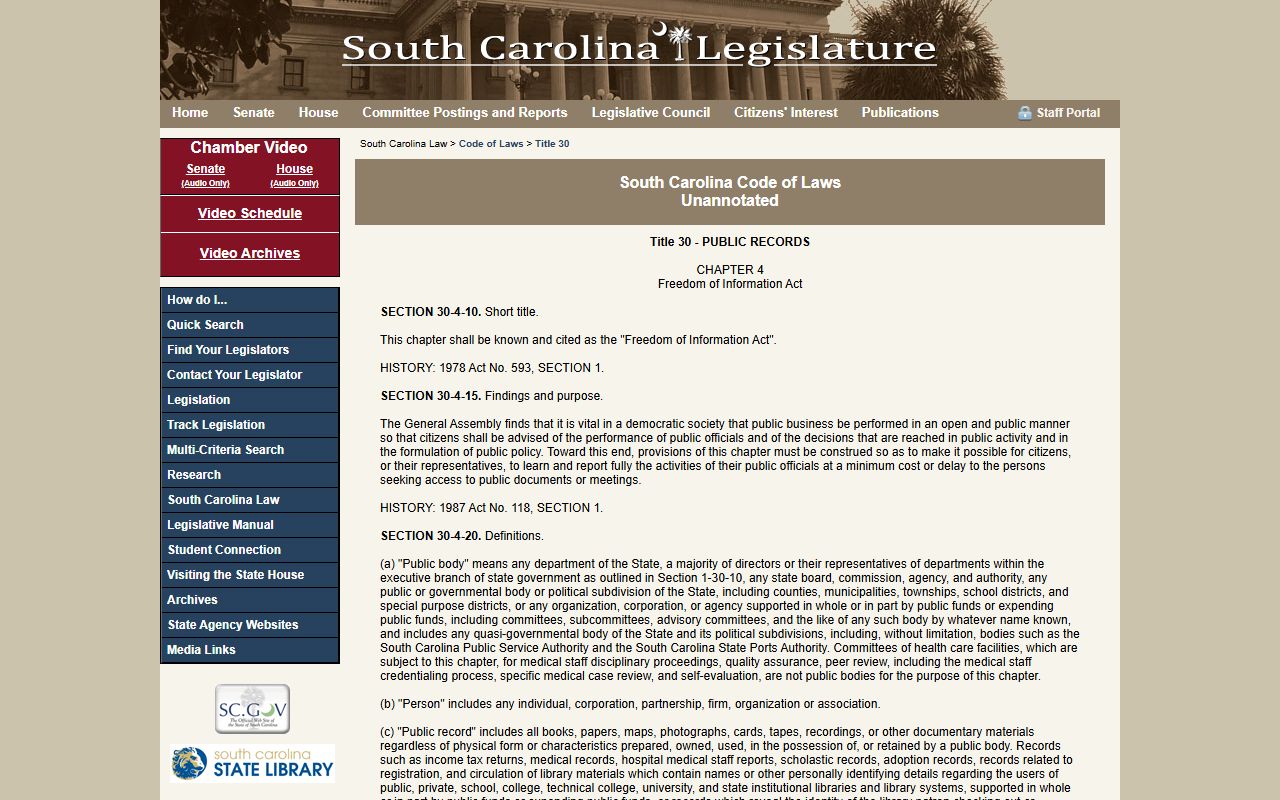
Under this framework, probate estate filings that are not sealed are generally available for public inspection at the Probate Court or through a records request, subject to any redaction of personal identifiers.
Opening an Estate Without a Will
When a person dies intestate, meaning without a will, the estate still goes through probate. The court appoints a personal representative rather than confirming an executor named in a will. South Carolina's intestacy laws control who inherits when there is no will, and the Probate Court oversees the process to make sure creditors are paid and assets reach the right heirs.
For an intestate estate in Charleston County, bring the original death certificate (copies are not accepted), a completed Form 300ES, and information about heirs, devisees, or successors as required. The filing fee still applies based on the value of probate assets, and creditor publication follows the same rules as a testate estate.
The distinction between testate and intestate primarily affects who acts as personal representative and how the remaining property is divided. The filing process at the court counter is largely the same, and both routes use Form 300ES as the starting document.
Charleston County Probate Fees
The Probate Court charges fees set by state statute, specifically S.C. Code § 8-21-770(B), and published on the county's probate fee schedule. The fees below reflect what the Estate Division page lists for opening an estate. The full fee schedule, including conservatorship and other fees, is available as a PDF through the county site.
| Item | Amount |
|---|---|
| Estate opening fee (based on probate asset value) | $25 to $95 |
| Creditor publication fee | $40 to $120 |
| Marriage license | $70 (plus credit card transaction fee) |
| Statutory estate and conservatorship fees | Per § 8-21-770(B) scale |
Two separate checks are required if you pay by check: one for the estate filing fee and one for the publication fee. If the date of death is more than one year before your filing, no publication is required and that fee is waived. Credit cards are accepted at the court window, but a processing fee is added. Cash is accepted without a surcharge.
Small Estate Affidavit in Charleston County
Not every death requires a full probate proceeding. South Carolina law at S.C. Code § 62-3-1201 allows a simplified process for collecting personal property when the estate is small. The Charleston County Probate Court uses Form 420ES, the Affidavit for Collection of Personal Property Pursuant to Small Estate Proceedings, for this purpose.
To use the small estate affidavit process, the total value of the entire probate estate, wherever the property is located, must not exceed $25,000 after subtracting liens and encumbrances. If the estate meets that threshold, the affidavit allows a successor to collect personal property without going through the full opening-an-estate steps. Real property is generally not covered under the small estate affidavit route.
This is one of the most practical tools for modest estates. It avoids publication costs and much of the court supervision that comes with a standard probate. Contact the Estate Division at (843) 958-5030 to confirm whether your situation qualifies before completing the form.
The screenshot below is from the U.S. Bankruptcy Court for the District of South Carolina, which handles federal bankruptcy matters that are separate from state probate. If a decedent had an active bankruptcy when they died, the federal bankruptcy case may affect how the estate is administered.
The U.S. Bankruptcy Court for the District of South Carolina is a federal court and is not part of the Charleston County Probate Court system.
Bankruptcy and probate can intersect when an estate has outstanding debts or when a bankruptcy trustee has a claim on estate assets. In those situations, heirs should consult an attorney who works in both areas before filing with the Probate Court.
Charleston County Probate Forms Library
The Probate Court maintains a large forms library at charlestoncounty.gov/departments/probate/forms-instructions.php. The library includes over 140 forms covering estate administration, guardianship and conservatorship, interpreter requests, video appearance waivers, in forma pauperis motions, and more. Most are available as PDFs. Several forms are marked mandatory, meaning the court will not process the filing without them.
The table below lists the core estate and guardianship forms you are most likely to need in a Charleston County proceeding.
| Form Number | Purpose | Mandatory |
|---|---|---|
| 300ES | Application (Informal) / Petition (Formal) for Probate of Will or Appointment | Yes |
| 301ES | Additional Devisees / Heirs / Successors | No |
| 302ES | Renunciation of Right to Administration and / or Nomination and / or Waiver of Bond | No |
| 305ES | Information to Heirs and Devisees | No |
| 306ES | Filing of Will for Record | No |
| 350ES | Inventory and Appraisement | Yes |
| 361ES | Accounting | Yes |
| 370ES | Notice to Creditors | No |
| 371ES | Statement of Creditor's Claim | Yes |
| 420ES | Affidavit for Collection of Personal Property (Small Estate) | No |
| 421ES | Verified Statement to Close Estate | No |
| 430ES | Petition for Sale of Real Estate | No |
| 480ES | Safe Deposit Affidavit | No |
| 530GC | Petition for Finding of Incapacity and / or Appointment of Guardian | Yes |
| SCCA405PC | Motion and Affidavit to Proceed In Forma Pauperis | No |
| SCRCP Form 6 | Confidential Reference List of Redacted Identifiers | No |
If you cannot afford court costs, Form SCCA405PC allows you to ask the court to waive fees. For any filing that contains sensitive personal identifiers such as Social Security numbers, driver's license numbers, or bank account information, those details should go on SCRCP Form 6 as a confidential reference rather than on public-facing documents.
Guardianships and Conservatorships
The Charleston County Probate Court's Guardianship and Conservatorship Division handles petitions when a person can no longer make safe decisions about their own care or finances. The process starts with a petition, followed by a court hearing where a judge decides whether guardianship or conservatorship is warranted and who should serve in that role.
A guardianship gives the appointed guardian authority over the personal decisions of a protected person, such as where they live, what medical care they receive, and day-to-day choices about their wellbeing. A conservatorship covers financial matters: managing bank accounts, paying bills, handling investments, and protecting assets. Courts sometimes appoint both a guardian and a conservator, and in many cases the same person serves both roles.
Form 530GC, the Petition for Finding of Incapacity and / or Appointment of Guardian, is the mandatory starting form for guardianship filings. The Guardianship and Conservatorship Division line is (843) 958-5180. Fees for conservatorship matters are governed by S.C. Code § 8-21-770(B) and scale based on the value of the assets under management.
Guardianship and conservatorship proceedings are more restricted than standard estate records. Because they involve a protected person's personal situation, medical history, and finances, public access to these files is more limited than access to routine estate filings.
What Charleston County Probate Records Show
The Charleston County Probate Court publishes a sample probate file at charlestoncounty.gov/departments/probate. The sample shows the types of documents and data fields that appear in a real estate file. Understanding what a probate file contains helps when you are searching for a particular document or trying to verify an estate's status.
A typical Charleston County probate file may contain the following fields and documents.
- County and Probate Court case caption, including the estate name and decedent's name
- Case number assigned by the court
- Personal representative or applicant name and fiduciary role
- Probate real property and personal property descriptions
- Asset values, income, and any liens or encumbrances
- Signatures, notary certifications, and court approval or signature blocks
- Inventory and Appraisement (Form 350ES), Accounting (Form 361ES), and closing statements
- Will, death certificate references, creditor notices, waivers, and claims
Sensitive personal identifiers, such as Social Security numbers, should not appear on public-facing forms. Those go on SCRCP Form 6 and are kept on the confidential reference list. Guardianship and commitment records carry additional access restrictions due to medical and privacy concerns.
The next image links to an AP report on federal findings related to South Carolina jail conditions. The report is relevant context for Charleston County detention oversight and conditions at the Al Cannon Detention Center, which is a separate facility from the Probate Court.
A 2026 AP report on federal findings related to South Carolina jail conditions addressed oversight concerns at county detention facilities, including Charleston County.

Detention matters and probate matters are handled by different offices: the Sheriff's Office and Al Cannon Detention Center handle custody, while the Probate Court at 100 Broad Street handles estates and guardianships.
How to Access Charleston County Probate Records
Probate records in Charleston County are not part of the Circuit Court Public Index used for Common Pleas and General Sessions cases. The Probate Court maintains its own filing system. For current estate records, the best path is to contact the Probate Court directly or visit in person during business hours. The court's Estate Division page at ccprobate.charlestoncounty.gov/estate.php covers active estate instructions, and the main probate page at charlestoncounty.gov/departments/probate links to forms, the fee schedule, and division contacts.
For historical research, note that copies of wills from 1671 to 1871, estate inventories from 1687 to 1785, and other early probate records are housed at the South Carolina Room of the Charleston County Main Library. Those records are not at the current Probate Court office at 100 Broad Street.
- Identify whether the estate was filed recently or historically. Recent filings are at the Probate Court; pre-1871 wills are at the Charleston County Main Library's South Carolina Room.
- Contact the Estate Division at (843) 958-5030 with the decedent's name and approximate date of death. Staff can confirm whether a case is on file and what records are available.
- Visit the Probate Court at 100 Broad Street during regular hours (Monday through Friday, 8:30 a.m. to 5 p.m.) to review open estate records in person.
- Request certified copies or plain copies as needed. Fees are set by the court's schedule and by statute. Bring payment; cash and credit cards are accepted.
- For guardianship or conservatorship records, call (843) 958-5180 first. Those files have more access restrictions than standard estate records.
The screenshot below links to S.C. Code § 62-3-1201, the small estate statute governing the affidavit collection process used for qualifying small estates in Charleston County.
South Carolina's small estate law at S.C. Code § 62-3-1201 allows collection of personal property by affidavit when the total probate estate does not exceed $25,000 in value.
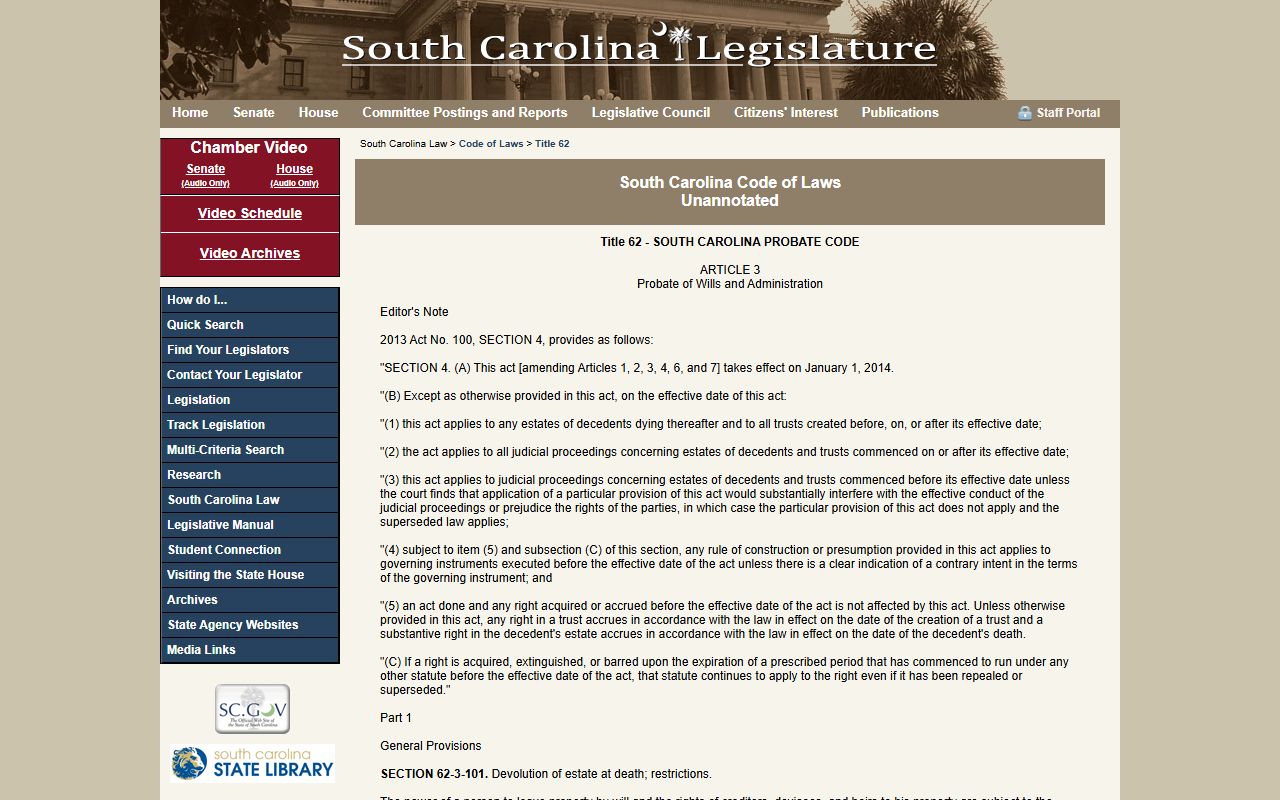
Families dealing with modest estates should review the small estate threshold before opening a standard probate, because the affidavit route is faster and costs less than filing through the full estate process.