
Active Warrants in Charleston County
The Charleston County Sheriff's Office is the central agency for warrant operations in the county. Under S.C. Code § 23-15-50, the Sheriff serves as a conservator of the peace and must arrest any person for whom a criminal warrant has been issued. The Warrants Unit operates inside the main lobby of the Sheriff Al Cannon Detention Center at 3841 Leeds Ave., North Charleston. The unit investigates and locates defendants, maintains physical control of warrant documents and juvenile pickup orders, and confirms that warrant information is complete, accurate, and current.
The public warrant database covers warrants reported by the Charleston County Sheriff's Office and authorized for public release. That is a narrower set than all active warrants in the county system. State and federal warrants, sealed warrants, and warrants issued by courts outside the Sheriff's jurisdiction may not show at all. The Sheriff's page warns clearly that the data is not official confirmation that a warrant is active, that information may be incorrect or not current, and that the database is not an official record of the county or its elected officials. Anyone checking a name on that portal should treat the result as a starting point, not a final answer.
The South Carolina Circuit Court system, including General Sessions for criminal matters, is one source of warrant-related filings in Charleston County. A view of the circuit court page from the South Carolina Judicial Branch shows the scope of trial-court operations that may generate warrant documents.
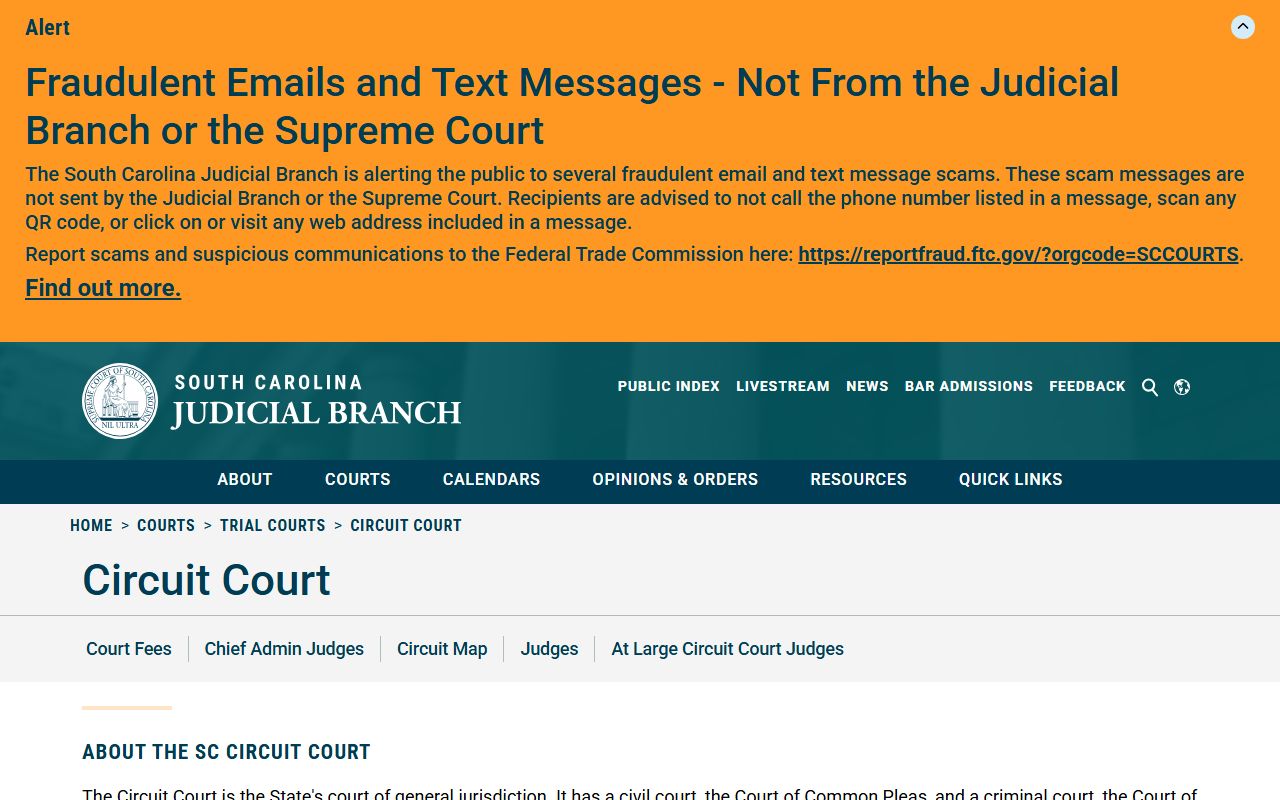
That page at sccourts.org explains the General Sessions side of Circuit Court, which is where most criminal warrants originate before landing with the Sheriff for service.
Types of Warrants in Charleston County
South Carolina courts and law enforcement issue several types of warrants. Each one has a different trigger and a different process for resolving it. Knowing which type applies to a situation helps determine the right steps to take and which office to contact first.
- Arrest warrant - a judge or magistrate signs this after reviewing evidence that probable cause exists for a crime; it directs law enforcement to take a named person into custody.
- Bench warrant - a judge issues this when a person fails to appear in court on a scheduled date; it is not based on a new crime but on a missed obligation to the court.
- Search warrant - a judge authorizes law enforcement to search a specific place or person for evidence; this type does not necessarily result in an arrest warrant against the property owner.
- VCL warrant (voluntary compliance) - a warrant type referenced by the Charleston County Warrants Unit for lower-level matters where a person can call ahead, make an appointment, and turn themselves in at Bond Court to resolve it.
- Capias / failure-to-appear - similar to a bench warrant in practice; a capias is directed at a person who has defaulted on a court order, often a magistrate-level fine or a court date.
The Warrants Unit does not distinguish publicly between warrant types on its search page, but the type of warrant affects how the resolution process works. A bench warrant from a missed magistrate date has a different path than a felony arrest warrant. Contact the Warrants Unit directly to confirm the type and the right steps for the specific matter at hand.
How to Search Charleston County Warrants Online
The Charleston County Sheriff's Office operates a public Warrants Search portal at charlestoncounty.gov. The search requires a last name at minimum and accepts an optional first name to narrow results. The portal does not require a login or an account. Results pull from warrants reported by the Sheriff's Office and cleared for public release.
- Open the Warrants Search page on the Sheriff's website.
- Enter the last name of the person you want to look up. The portal requires this field; without a last name the search will not run.
- Add a first name if you want to narrow the results, especially for common last names.
- Run the search and review any results that appear. Each listing will show identifying and warrant-related information for the match.
- Do not act on results alone. The Sheriff's page explicitly states that results are not official confirmation a warrant is active. Call the Warrants Unit at (843) 529-7391 during business hours to verify any result before drawing conclusions.
For emergencies, call or text 911. Non-emergency calls go to (843) 202-1700. Anyone who finds warrant information and is not sure what to do should contact the Warrants Unit during its weekday hours rather than relying on the online result alone.
Court rules governing public access to judicial records in South Carolina shape which warrant-related documents are publicly available online. The state appellate court rules address what counts as a judicial record and when bulk or compiled extraction is restricted.
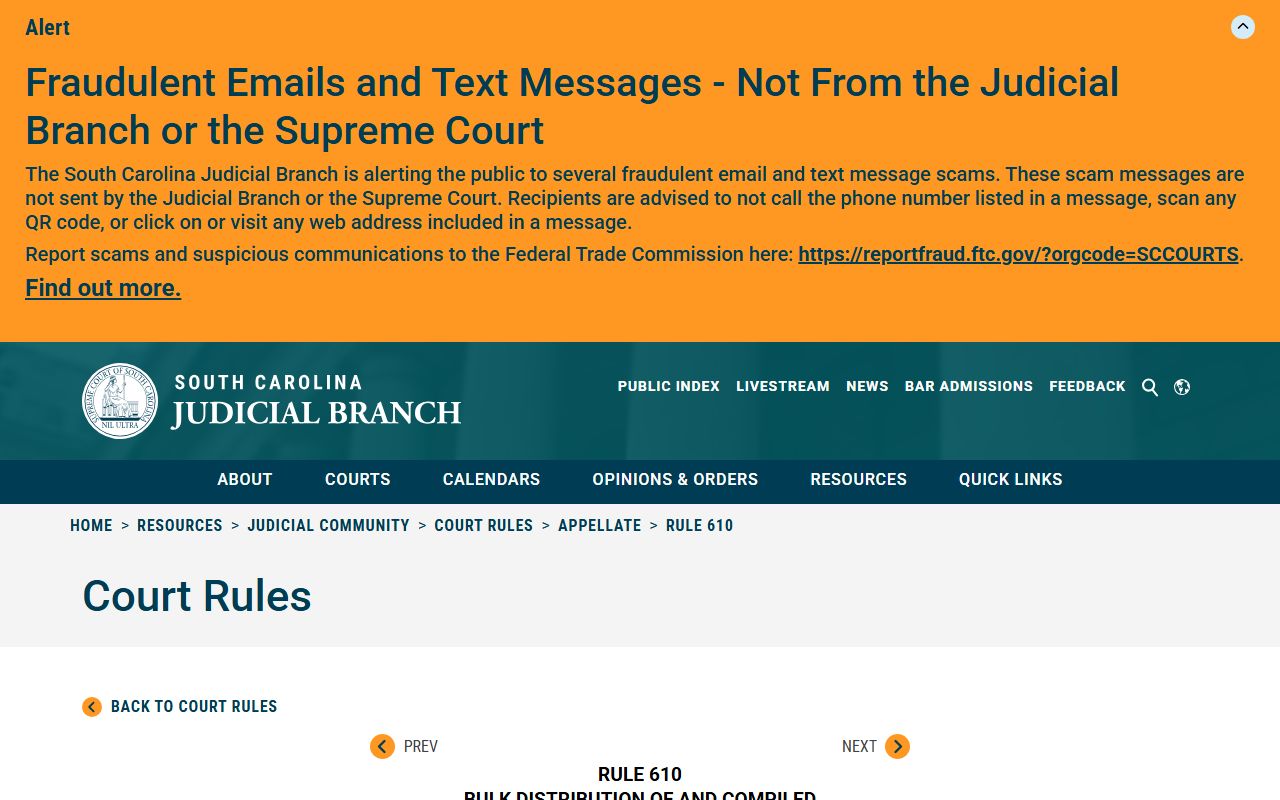
That page at sccourts.org is SCACR Rule 610, which defines judicial records and sets limits on automated bulk data pulls from court systems, a rule that also applies to warrant-adjacent case data.
Charleston County Warrant Search Fields
The warrant search form is deliberately simple. Only the last name field is required. The first name is optional and works as a filter when a last name alone produces too many results. No account, date of birth, or case number is needed to run a basic search. The table below shows the fields as they appear on the portal.
| Field Label | Type | Required | Notes / Format |
|---|---|---|---|
| Last Name | Text | Yes | The only required field. The portal instructs users to search by LAST name only or by a combination of LAST and FIRST. Enter the exact last name or a partial spelling. |
| First Name | Text | No | Optional. Use with last name to narrow results when the last name alone returns a long list. |
| Search Warrants | Submit button | n/a | Runs the query against the Sheriff's warrant database. |
Important: Results from the warrant search portal are not official confirmation that a warrant is active and are not probable cause for arrest; information may be incorrect or not current.
What a Charleston County Warrant Record Shows
When a result appears in the warrant search, it pulls from the data fields the Sheriff's Office tracks for each warrant in the public database. The exact columns shown may vary by entry, and some fields may be blank if the information is incomplete or withheld. The Sheriff also warns that wanted persons sometimes use false identification, so names, dates of birth, and other details tied to the warrant may not belong to the person who is actually being sought.
| Field | What It Shows |
|---|---|
| Name | The name associated with the warrant as reported by CCSO; may include aliases if the subject uses multiple names. |
| Date of Birth / Age | The birth date or age tied to the warrant record; may not match the actual subject if false ID was used. |
| Warrant Type | The category of warrant, such as arrest, bench, or VCL, if included in the public release. |
| Charge | The offense or court default that generated the warrant. |
| Issuing Agency or Court | The office or court that issued the warrant and directed its service. |
| Warrant Number | A unique identifier assigned by the court or Sheriff to the warrant document. |
| Contact Instructions | Directions from the Sheriff on how to act on the information, typically pointing to the Warrants Unit phone number rather than encouraging direct public action. |
Note: Citizens should not take individual action based on the warrant search results; the portal instructs anyone with active warrant information to contact the Warrants Unit or local law enforcement rather than confront a subject.
What to Do If You Have an Outstanding Warrant
Finding your own name in the Charleston County warrant search, or learning through another channel that a warrant may be out for you, does not mean you should panic or ignore the situation. The worst option is to wait and risk an unplanned arrest at an inconvenient time or place. The Warrants Unit is set up to help people resolve warrants voluntarily, and the process is often smoother than an unexpected roadside or workplace arrest. Talking to a criminal defense attorney before making contact is a reasonable step, especially for serious charges.
For a VCL warrant, the Sheriff's Office outlines a clear path. Call the Warrants Unit at (843) 529-7391 during business hours and make an appointment to meet a deputy at Bond Court. The warrant is served at that meeting, a bond hearing follows at the Centralized Bond Hearing Court at 3831 Leeds Ave., Suite 200, North Charleston, and many voluntary turn-ins receive a personal recognizance (PR) bond, which means release without cash bail. After the hearing, the person is photographed, fingerprinted, given a court date, and released if bond allows.
For a missed magistrate court date, the first call should go to the magistrate office to check whether a bench warrant was actually issued. If no warrant exists yet, the fine may still be payable. If a bench warrant was issued, contact the Warrants Unit, bring the exact cash amount of the fine, and the deputy may serve the warrant at Bond Court, the fine may be paid, and the person may be photographed, fingerprinted, and released. After-hours contact for serious warrants or weekend situations goes to (843) 202-1700 or Consolidated Dispatch at (843) 743-7200.
The U.S. Court of Appeals for the Fourth Circuit has jurisdiction over South Carolina federal matters. Federal warrants operate on a separate track from the county system and require different steps to resolve.
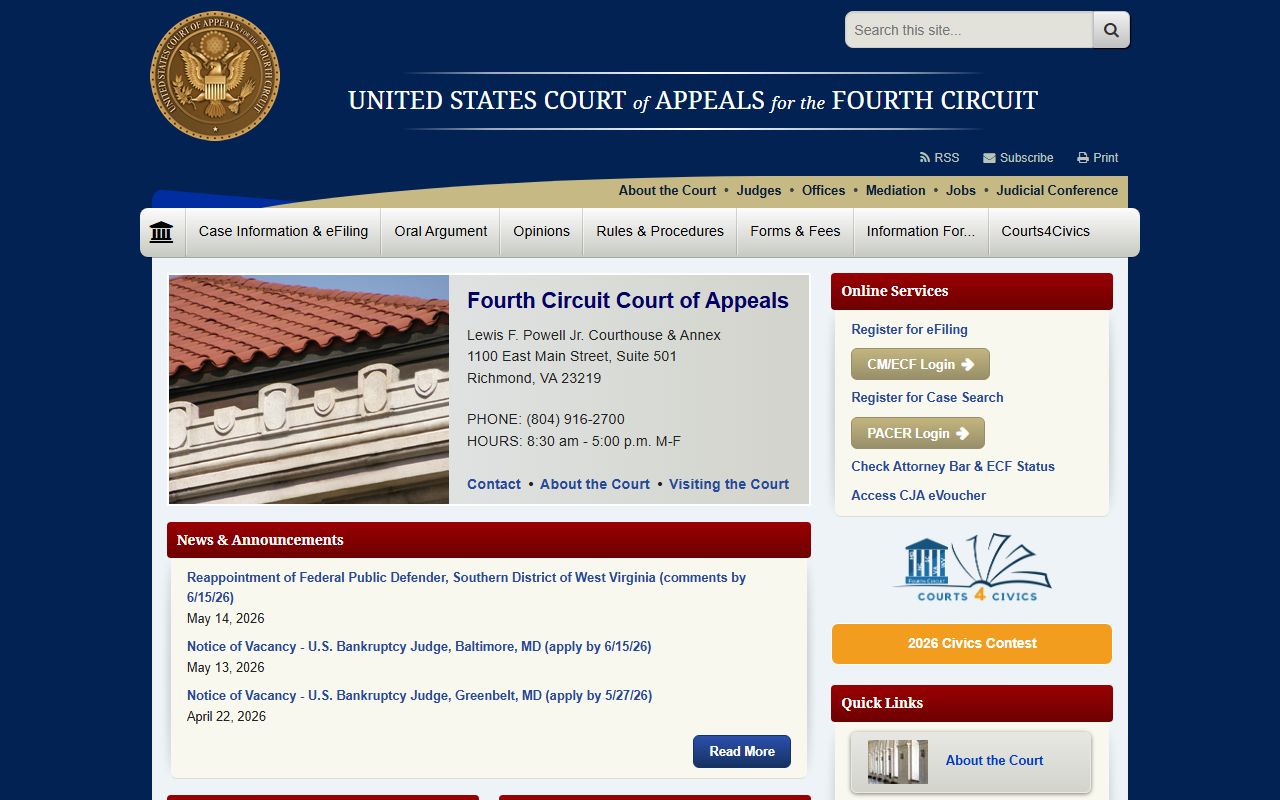
That page at ca4.uscourts.gov covers the federal appellate court that reviews South Carolina cases; anyone facing a federal warrant should consult an attorney rather than contact the county Warrants Unit, because federal and county processes are entirely separate.
Bond Hearings After a Warrant Is Served
Once a warrant is served, whether voluntarily or by arrest, the next step for most people is a bond hearing. Charleston County holds centralized bond hearings at the Centralized Bond Hearing Court at 3831 Leeds Ave., Suite 200, North Charleston, SC 29405. Hearings run on a daily schedule so that people who come in do not wait more than a few hours before seeing a magistrate.
Centralized Bond Hearing Court
3831 Leeds Avenue, Suite 200
North Charleston, SC 29405
Mon-Fri: 10:00 a.m., 2:00 p.m., and 6:00 p.m.
Weekends / holidays: 10:00 a.m. and 2:00 p.m.
Charleston County Warrants Unit
3841 Leeds Avenue (inside main lobby)
North Charleston, SC 29405
(843) 529-7391
Warrants@CharlestonCounty.org
Mon-Fri 7:00 a.m.-5:30 p.m.
After-hours: (843) 202-1700
At the bond hearing, the magistrate advises the defendant of the charges and rights and sets bond. A defendant does not enter a guilty or not-guilty plea at the bond stage. The amount set can range from a personal recognizance bond, which requires no cash, to a cash amount or a denial for the most serious charges. Once bond is set, the person is photographed and fingerprinted if not already done, then released if conditions are met. For Charleston County inmate records, use the separate inmate search if the person has been booked into the detention center.
Expungement After Warrant-Related Charges
A warrant itself is not the same as a conviction. If the underlying charge that generated an arrest warrant was later dropped, dismissed, or ended in a not-guilty verdict, the arrest record and related documents may qualify for expungement. An expungement removes the matter from public access under the court order that grants it. South Carolina law covers expungement procedures under S.C. Code § 23-15-50 and related statutes.
The process for a person arrested by the Charleston County Sheriff's Office runs through two offices. First, get a disposition from Sheriff's Records. Then take that document to the Ninth Circuit Solicitor's Office at the O.T. Wallace County Office Building, 101 Meeting Street, Charleston, phone (843) 958-1900. The Solicitor reviews the case and determines whether the person qualifies for an order of expungement. Fees are paid separately as certified checks or money orders, and the amounts vary by type of expungement. The Charleston County Public Defender's office at (843) 958-1850 can provide referrals for people who cannot afford legal help with this process.
South Carolina law at the Statehouse website sets the rules for how the Sheriff must handle warrants and arrests under his duty as a conservator of the peace.
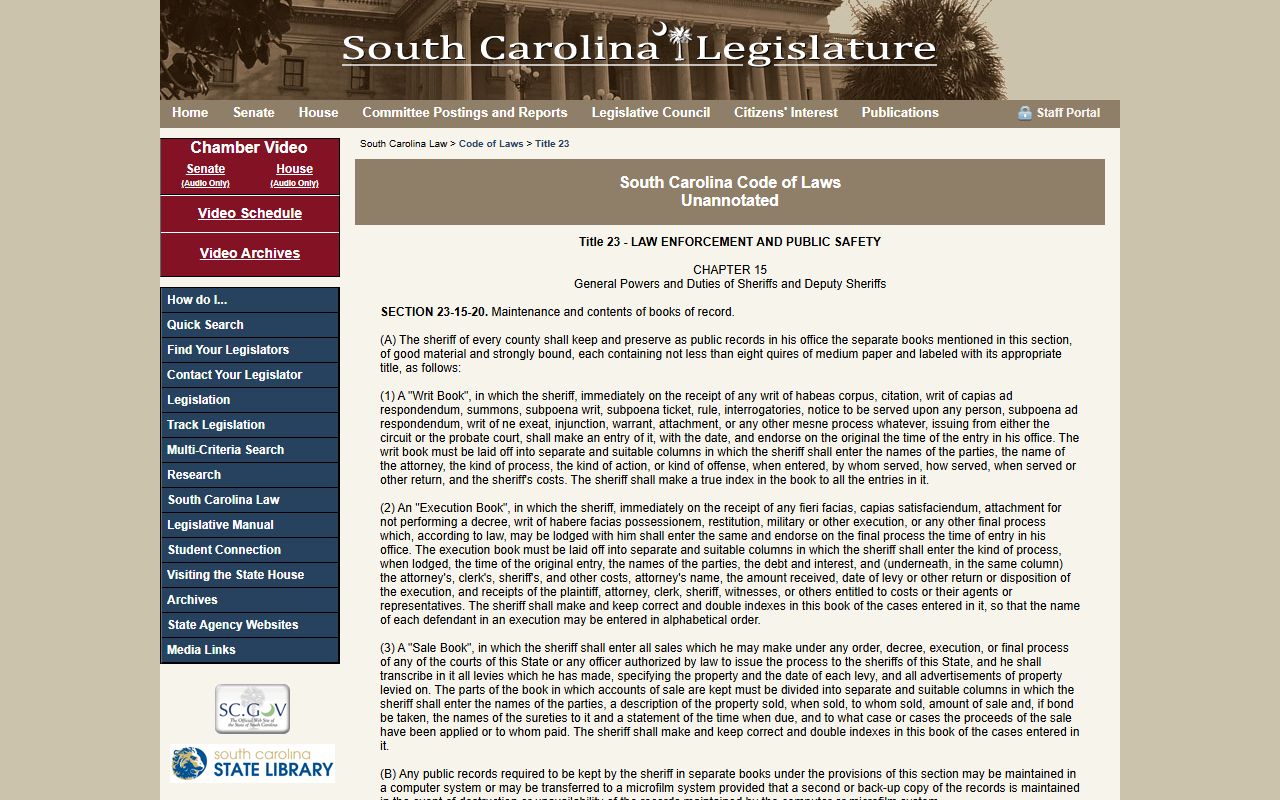
That page at scstatehouse.gov is S.C. Code Title 23, Chapter 15, which governs the Sheriff's powers and duties, including the obligation to arrest on criminal warrants, a foundational statute for how Charleston County warrants are handled.
Restricted and Limited Charleston County Warrant Information
Not all warrants appear in the public database. The Sheriff's system only includes warrants reported by the Charleston County Sheriff's Office and specifically authorized for public release. Several categories sit outside that scope entirely, and a clean result on the public portal does not mean no warrant exists.
- Juvenile pickup orders - the Warrants Unit maintains these separately; they are not listed in the public search.
- Sealed warrants - a judge can order a warrant sealed, which removes it from any public-facing record.
- Warrants from other agencies - warrants issued by other counties, state police, or federal law enforcement are not in the Sheriff's county database.
- Federal warrants - these come from federal courts and are handled by the U.S. Marshals; the county portal does not include them.
- Search warrants - these are generally sealed until executed and are rarely part of a public warrant search.
Grand-jury proceedings are confidential in South Carolina, and a grand-jury indictment may generate an arrest warrant that does not appear publicly until after service. Law-enforcement investigative records also carry exemptions under the state Freedom of Information Act that can keep related warrant information from appearing in any public search. For the most current and complete picture, the only reliable source is the Warrants Unit itself during business hours.
A local news report from WIS-TV published in March 2026 covered a high-profile event involving the Charleston County detention system, a reminder that the Sheriff Al Cannon Detention Center and its warrant operations remain under public and media scrutiny.
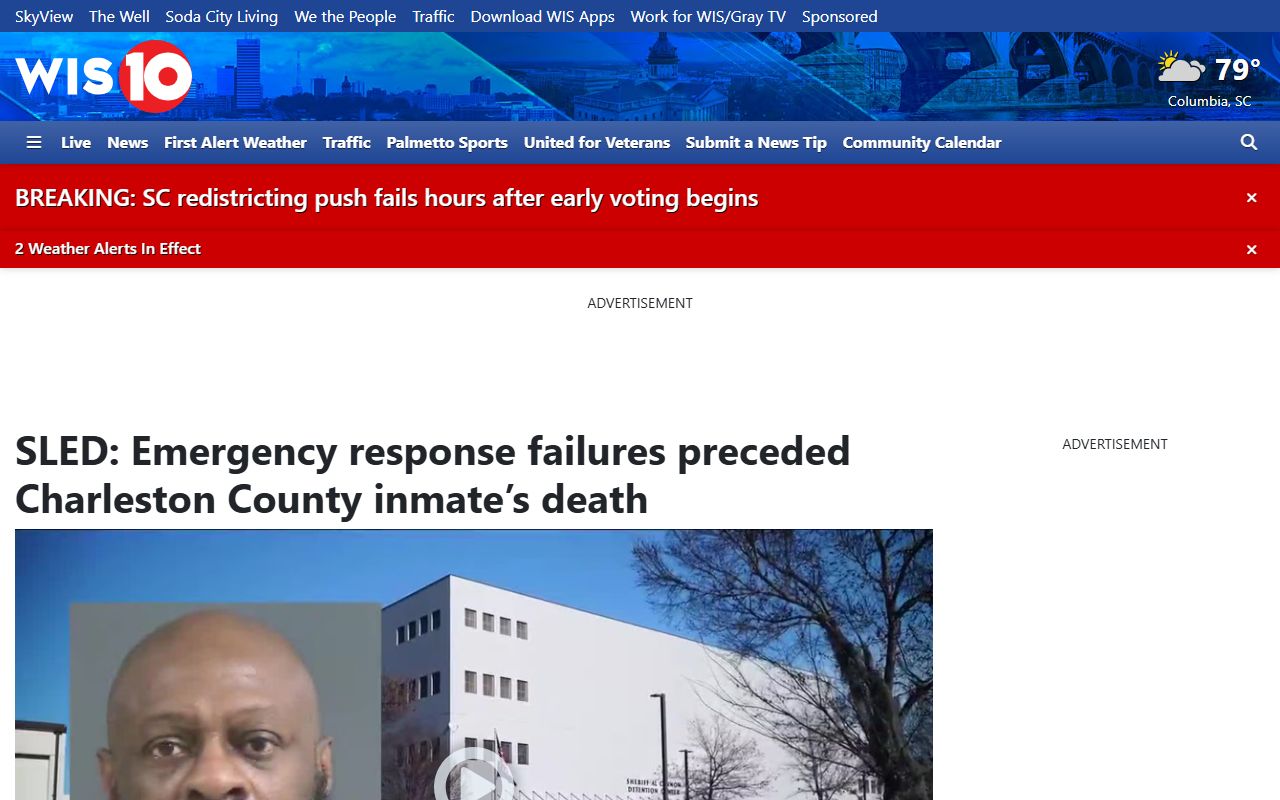
That WIS-TV report from wistv.com, published March 31, 2026, covered an SLED review of the detention center; it is cited here only as a dated reference to public reporting on the facility, not as legal or operational guidance.
Reporting Warrant Tips and Crime Information
Anyone with information about a person known to have an active warrant can contact the Charleston County Sheriff's Office directly through its non-emergency line at (843) 202-1700 or the Warrants Unit at (843) 529-7391. Tips may also be submitted through the Sheriff's Warrants page. Tips about serious crimes can go to Captain Paul Tittle at (843) 554-2459 or to Sergeant J. Mizner at (843) 529-3512.
The Sheriff's Office advises the public not to confront a person believed to have an active warrant and not to take individual action based on information found in the online database. Public safety is the agency's responsibility. If a situation poses immediate danger, call 911 or text 911 rather than attempting to act on warrant information directly.