
South Carolina Freedom of Information Act
South Carolina's Freedom of Information Act is codified at Title 30, Chapter 4 of the South Carolina Code. The act covers public bodies at every level, including Charleston County and its departments. Under S.C. Code § 30-4-10, the act establishes the basic right of citizens to know what their government is doing. That means county administrative records, policies, contracts, meeting minutes, and most correspondence held by county agencies are presumptively open to public inspection.
The definition of "public body" under S.C. Code § 30-4-20 is broad. It reaches counties, municipalities, school districts, special-purpose districts, and any organization supported by public funds. Charleston County agencies, the Sheriff's Office, the Clerk of Court in its administrative capacity, and similar county offices all fall under that umbrella. The practical result is that most county records are public by default unless a specific statutory exemption applies.
The right to inspect and copy public records, plus the fee rules, sits in S.C. Code § 30-4-30. Agencies may charge reasonable fees for search, retrieval, redaction, and copying. They must respond within set deadlines. A 10-business-day period and a 20-business-day period are referenced in state FOIA practice depending on the nature and age of the records sought. Charleston County uses the StreamlineGov portal to receive and track FOIA requests from the public.
The South Carolina Family Court handles several of the record types that come up in public-records research, including protective orders, divorce, and juvenile matters. A look at the Family Court's official page gives context for what those files contain and which restrictions apply.
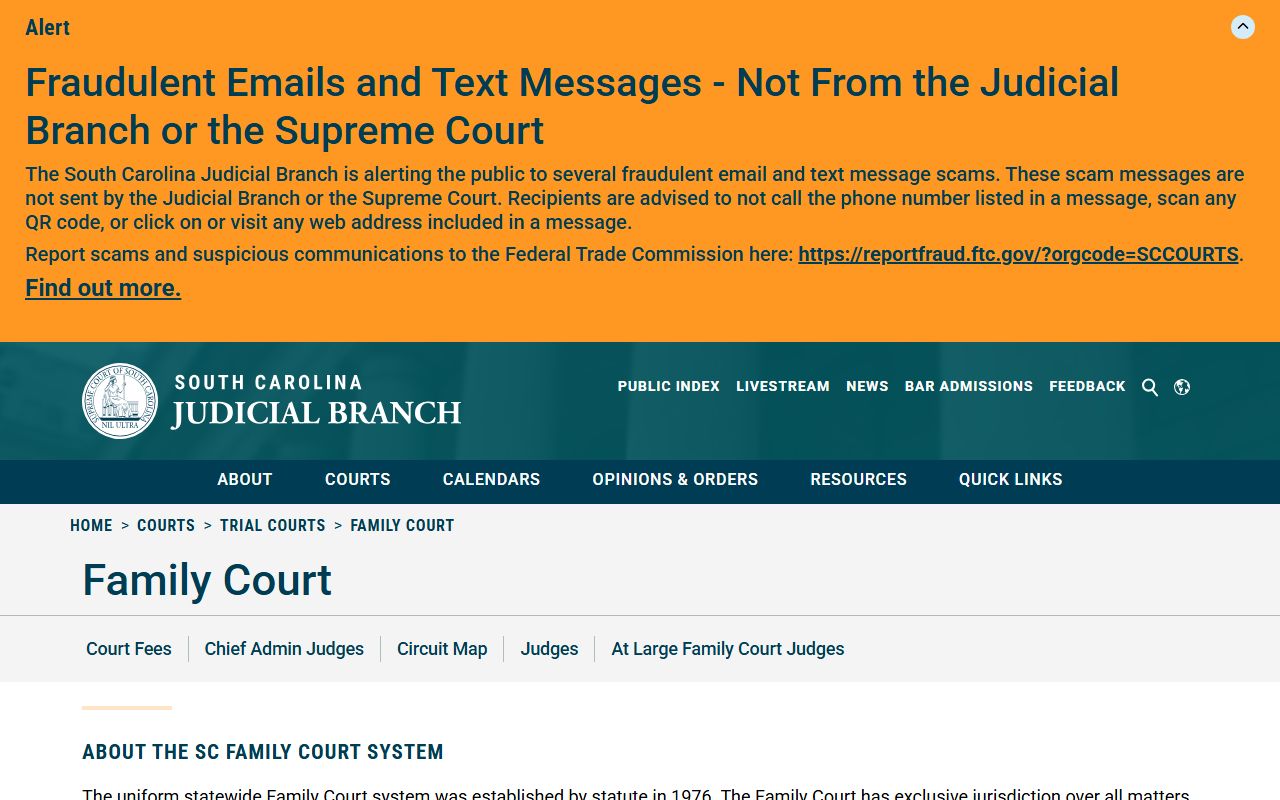
Family Court records for divorce and custody fall under judicial records rules, not a standard FOIA request. The court's own access rules and redaction requirements govern those files through the Clerk of Court.
Court Records vs. County Records
Most people searching for a specific case, a judgment, a divorce decree, or a criminal charge do not need to file a FOIA request. Those files live in the court system. Circuit Court and Family Court records are held by Clerk of Court Julie J. Armstrong at 100 Broad Street, Suite 106, Charleston, SC 29401, phone (843) 958-5000. Probate records are with Charleston County Probate Court at the Judicial Center. Magistrate records go through Summary Court Administration at 4045 Bridge View Drive, North Charleston. All of those offices have their own access routes, and the Charleston County court records portal covers Circuit Court files online.
FOIA is the right tool for county administrative records: Sheriff's Office incident reports after an investigation closes, detention center policies, county contracts, and county meeting minutes. If you want records that are administrative or law-enforcement in nature rather than court files, FOIA is the path. One firm limit: a FOIA request cannot override a court order sealing a record or a statutory confidentiality rule. Judicial records are also subject to South Carolina Appellate Court Rule 610, which controls bulk distribution of compiled court data separately from the county FOIA process.
The Veterans Treatment Court run out of the Charleston County Judicial Center is one example of a program that generates records on both the court and administrative sides. Its official page shows eligibility and program structure.
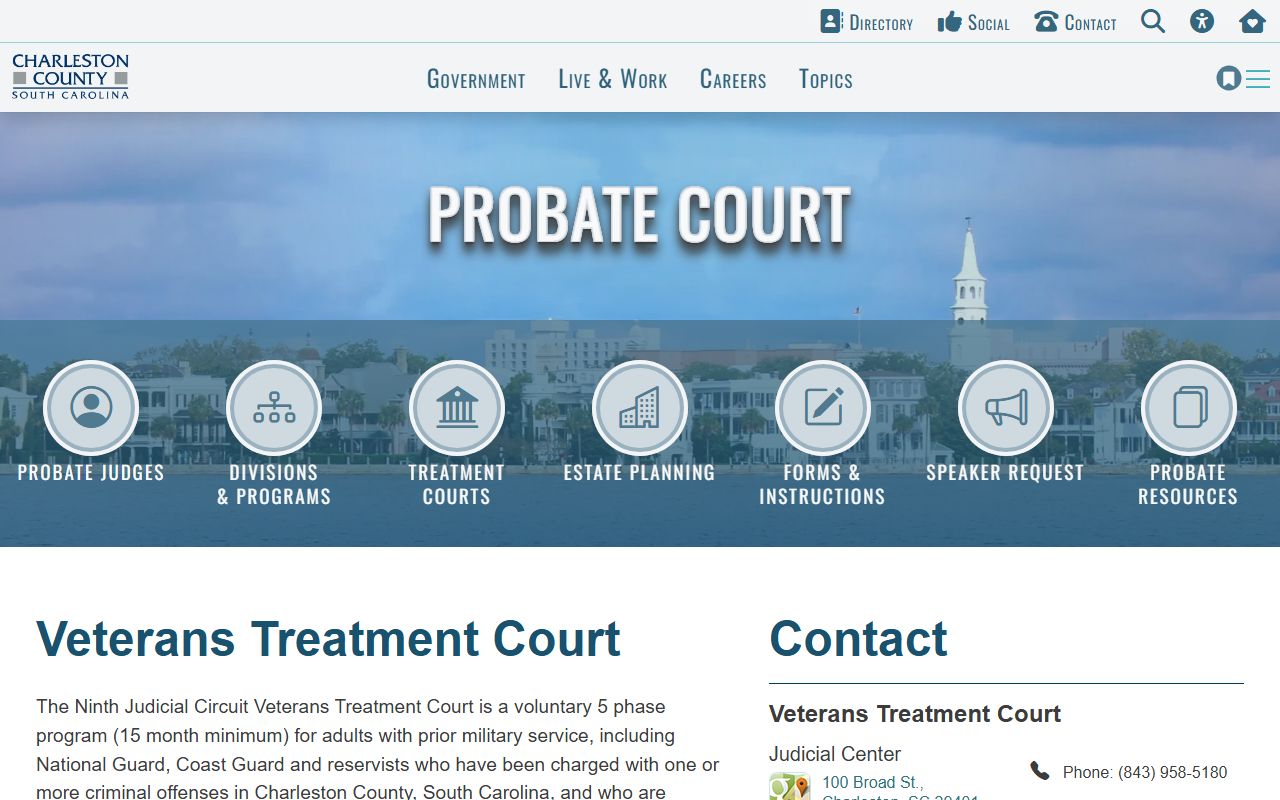
Program records from specialty courts like this may involve both judicial files held by the Clerk and administrative tracking held by the program office. Ask each office separately about what they hold.
Note: Sealed records, juvenile court files, adoption records, and grand-jury materials cannot be obtained through FOIA regardless of how the request is framed.
What Charleston County Agencies Maintain
Several county offices hold records that are outside the court system but are still public under state law. The Register of Deeds handles land records, deeds, mortgages, and property transfers. Probate Court holds marriage licenses, estate files, guardianship and conservatorship records, and commitment orders. The Sheriff's Office maintains incident reports, arrest blotters, and detention records. The County Council and its departments produce budgets, contracts, meeting minutes, and policy documents. Each of those offices is a separate custodian of its own records, and a FOIA request goes to the office that holds the file, not to a central clearinghouse.
Here are the main record categories held by Charleston County agencies outside the court system.
- Property deeds, mortgages, and land transfers through the Register of Deeds.
- Marriage licenses from Probate Court, Suite 469, Judicial Center.
- Sheriff's incident reports and law-enforcement records subject to FOIA exemptions.
- County Council meeting minutes, ordinances, and public contracts.
- Detention center administrative policies and accreditation documents.
- Budget records, procurement files, and county department correspondence.
For court-generated records such as civil judgments, criminal case files, or probate records, contact the office that runs that court rather than submitting a FOIA request. The Clerk's office and probate office each have their own copy-request process and fee schedules that work faster than the FOIA route for filed cases.
How to File a Charleston County Public Records Request
Charleston County processes FOIA requests through the StreamlineGov portal. That portal lets you identify the department, describe the records you want, and track your request through the county's review process. Submitting through the portal creates a record of the request and its status, which can help if you need to follow up or challenge a denial. Some offices may also accept written requests by mail or email, but the StreamlineGov portal is the county's designated public-records request channel.
- Identify the county office that holds the records you want. For incident reports, that is the Sheriff's Office. For property records, that is the Register of Deeds. For county policies or contracts, that is the relevant county department. Do not direct a FOIA request to the Clerk of Court for ordinary court case files; use the Public Index or the Clerk's copy-request process instead.
- Open the Charleston County FOIA portal at charlestoncounty.streamlinegov.us. Create an account or log in if you have used the portal before.
- Select the department that holds the records. Describe the records as specifically as possible: type of document, approximate date range, names involved, case or incident numbers if known, and the subject matter. A clear description speeds up retrieval and reduces the chance of an overbroad or incomplete response.
- Submit the request and note your confirmation number. The agency has up to 10 business days to respond with a determination or, for older or more complex records, may have additional time under the statute. Track the status in the portal.
- When the agency responds, it will either provide the records, deny the request with a stated reason, or indicate that responsive records do not exist. If records are provided, pay any applicable fees for search, retrieval, redaction, and copying before the records are released. The county will tell you the cost before you pay.
Public Records Request Form Fields
The StreamlineGov portal collects the information the county needs to find and review your request. The fields below reflect what a standard FOIA request form asks for in South Carolina. Providing complete information in each field reduces back-and-forth and avoids delays. You do not need to explain why you want the records; South Carolina FOIA does not require a requester to state a reason.
| Field | Required | Notes |
|---|---|---|
| Requester Name | Yes | Your full legal name; the county needs this to process and respond to the request. |
| Contact Information | Yes | Mailing address, email, or phone number so the agency can send its determination and any fee estimate. |
| Department / Agency | Yes | Select the specific county office that holds the records. Misdirected requests may need to be re-routed, which adds time. |
| Description of Records | Yes | Be specific: document type, date range, names or case numbers involved, subject matter. Vague descriptions produce vague results. |
| Date Range | No | Narrows the search and reduces retrieval cost. Provide approximate dates when known. |
| Format Preference | No | Indicate whether you want paper copies, electronic files, or inspection only. Electronic delivery may reduce fees. |
| Fee Waiver Request | No | If you believe fees should be waived (for example, for a news-media request or public-interest purpose), state your basis in the request. |
Public Records Fees in Charleston County
South Carolina FOIA allows agencies to charge reasonable fees for search, retrieval, redaction, and copying. The statute at S.C. Code § 30-4-30 governs what agencies may charge. For court records obtained directly through the Clerk of Court, a separate fee schedule applies. The Clerk's fees are set by statute and county schedule and are distinct from FOIA copy fees. The table below covers the Clerk's published rates for court record copies; FOIA fees for non-court county records depend on the specific agency and the scope of the search.
| Item | Amount |
|---|---|
| Copies (xerox/computer/microfilm), per page | $0.11 |
| Record retrieval | $4.00 per record |
| Certificate under seal of Clerk of Court | $10.00 |
| Exemplification | $10.00 |
| Expungement (dismissed/nol prossed/not guilty) | $35.00 |
| Motion fee | $25.00 |
| Common Pleas/domestic relations filing fee | $150.00 |
| Civil appeals (Small Claims, Probate, evictions) | $150.00 |
The Clerk accepts cash, money order, cashier's check, and major credit cards (Visa, MasterCard, American Express, Discover) in person. Credit cards carry a $1 non-refundable portal fee and a 1.7% convenience fee when applied online. Cashier's checks should be made payable to "Clerk of Court." Cash bonds cannot be paid by credit card. For county FOIA requests outside the court system, the specific department will provide a fee estimate before releasing records, and you can choose to modify or withdraw the request if costs are higher than expected.
Charleston County Public Index and Privacy Removal
The Charleston County Public Index is the free online search tool for Circuit Court records. It is not a county FOIA portal; it is a judicial records portal. Records in the Public Index are governed by judicial rules, not the county FOIA statute. South Carolina E-Filing Rule 10 sets redaction requirements for sensitive information in e-filed documents. Confidential reference lists, which list redacted identifiers, are not available to the public through the case-management public index.
The Public Index carries a specific privacy-removal notice. Any person whose Social Security number, driver's license number, state ID number, passport number, checking or savings account number, credit or debit card number, PIN code, or password appears in a publicly available internet copy of an official record may request removal of that identifier. That removal applies to the online image, not to the official court file itself. The Clerk's office handles those requests separately from a FOIA request. The Public Index also prohibits data scrapers and automated tools used for repeated commercial extraction of data.
South Carolina Appellate Court Rule 610 addresses bulk distribution and compiled information from judicial records. It restricts commercial use of compiled court data and requires authorization from Court Administration for bulk transfers. That rule sits alongside the FOIA framework and applies specifically to judicial records as a separate category.
Sheriff's FOIA and Incident Records
The Charleston County Sheriff's Office maintains incident reports, arrest blotters, law-enforcement records, and detention-center records. These are county records, not court records, so the FOIA framework in S.C. Code Title 30, Chapter 4 governs access rather than the Clerk's copy-request process. The Sheriff's Office has its own FOIA request form and accepts requests through the county's StreamlineGov portal. For media inquiries, the Sheriff's public information office handles those requests as well.
Not every law-enforcement record is open. S.C. Code § 30-4-40 lists the exemptions that apply to law-enforcement materials. Active investigation files, records that would identify confidential informants, materials that could endanger an ongoing prosecution, and records that would invade personal privacy are among the categories that agencies may withhold. Once an investigation is closed and prosecution is complete, many incident-related records become accessible, but the agency still reviews each request under the exemptions before releasing.
Federal law enforcement for the Charleston area is handled by the U.S. Attorney's Office for the District of South Carolina. Federal court and federal agency records follow separate access rules under the Freedom of Information Act at the federal level, which is a different statute from South Carolina's state FOIA.
Federal records requests go to the relevant federal agency under the federal FOIA statute. A request to the county FOIA portal will not produce federal documents; those are held by agencies like the U.S. Attorney's Office, the FBI, or other federal entities, each with their own request process.
Restricted and Confidential Records
Some records are off-limits regardless of how or where the request is submitted. South Carolina law restricts access to several categories that come up often in Charleston County searches. Understanding which records fall into these categories helps you avoid a wasted request and plan an alternative approach when one exists.
- Juvenile court records, which are Family Court matters. Expungement of juvenile records involves the solicitor, the Department of Juvenile Justice, and SLED.
- Sealed court records, closed by court order or statute, are not accessible through FOIA or a standard copy request.
- Expunged criminal records, once removed from public access by court order.
- Adoption records, which require statutory authorization or a court order to access.
- Mental-health and commitment records from Probate Court, which are highly restricted due to medical privacy rules.
- Grand-jury proceedings, which are confidential. Indictments become public after filing, but the deliberative process does not.
- Active law-enforcement investigative materials under the exemption in S.C. Code § 30-4-40.
For criminal records that have been expunged, even a law-enforcement check will typically not find the record. If you believe your own record qualifies for expungement, the process in Charleston County starts with obtaining a disposition from the Sheriff's Records office and taking it to the Ninth Circuit Solicitor's Office at the O.T. Wallace County Office Building, 101 Meeting Street.
South Carolina's Department of Probation, Parole and Pardon Services handles post-conviction supervision and pardon records. Their records are state-level, not county FOIA records, and requests go to that agency directly.
Pardon and parole records at the state level are maintained by that department; a Charleston County FOIA request would not produce those files because they are held by a separate state agency rather than a county public body.
If Your Charleston County Request Is Denied
When a county agency denies a FOIA request, it must state the reason for the denial and cite the specific exemption it is relying on. A blanket refusal without explanation does not comply with the statute. Under S.C. Code § 30-4-100, a person whose request is improperly denied can seek injunctive relief through the courts. That means filing a civil action asking a court to order the agency to produce the records. The court can award attorney's fees and costs to a prevailing requester if the agency withheld records without a lawful basis.
Before going to court, consider writing back to the agency to ask for a more specific explanation of the exemption claimed. Sometimes a denial covers only part of the responsive records, and the agency can produce redacted versions of the rest. Partial releases are common when a document contains both public information and exempt information; the agency should redact only the exempt portions rather than withhold the whole document.
There is no state ombudsman or administrative appeal board for South Carolina FOIA denials. The statute's enforcement path is a court action. If you need help evaluating a denial, the South Carolina Bar's public legal help resource and South Carolina Legal Services can provide referrals. For contested public-records matters with broader public interest, media organizations and press-freedom groups sometimes intervene or advise requesters on the strength of a claim.