
How to Search Charleston County Court Records
Most public court files in the county are searched through the Charleston County Public Index. The index covers Circuit Court records, which means both Common Pleas civil cases and General Sessions criminal cases. You can search by a party name or by a case number. The South Carolina Judicial Branch case search page links to the same county index and to other trial courts. Before you start, it helps to know the full name of a party, the rough year of the case, and which court would have handled it.
Search by case number when you have it. A number search is the cleanest path because names get misspelled and people use aliases. If you only have a name, enter the last name first, then add the first name to narrow the list. Family Court matters, juvenile cases, and sealed records may not show in the public index.
The county lists a clear set of steps for a typical search. The Clerk of Court homepage at clerkofcourt.charlestoncounty.org is a good launch point and shows the office contacts.
A look at the Clerk of Court website shows where the search links and office hours sit.
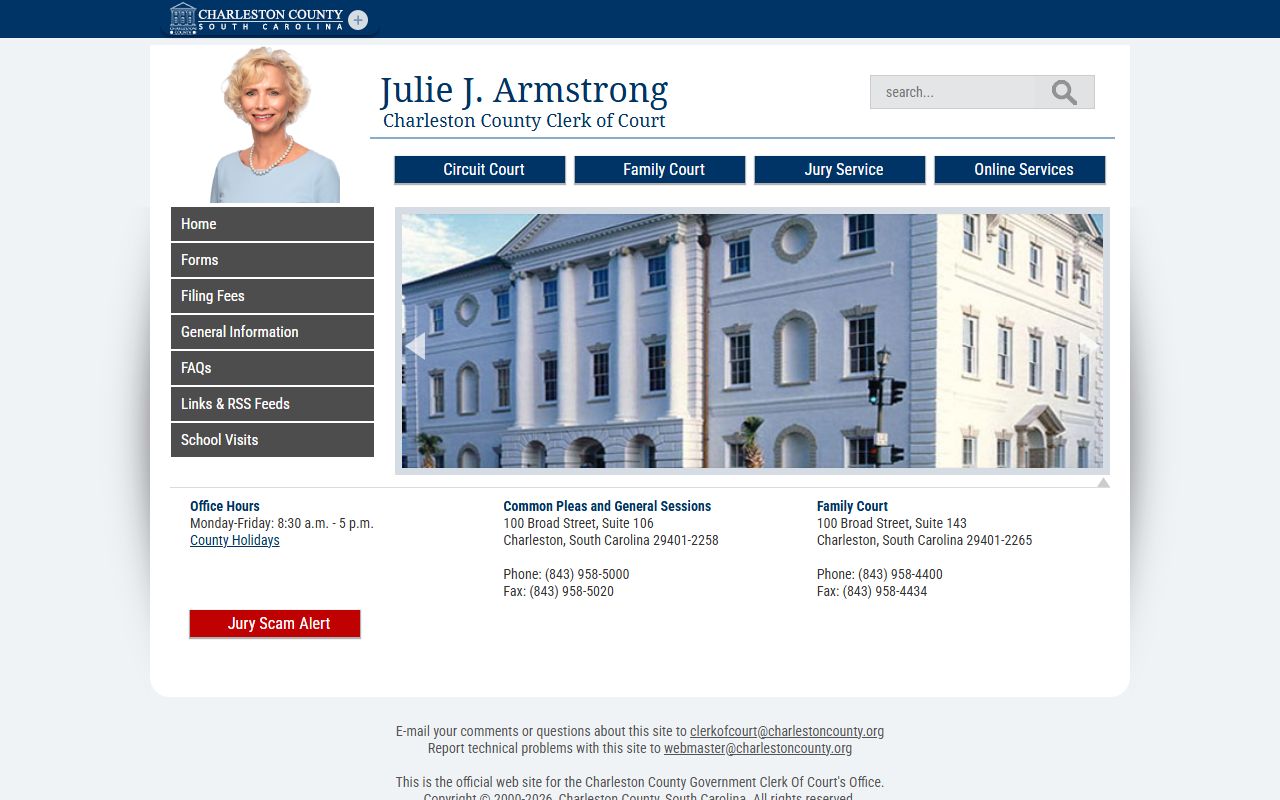
From that page you can reach the Public Index, forms, the fee schedule, and the FAQ that the Clerk keeps current.
- Open the Charleston County Public Index from the Clerk homepage or the state case search page.
- Pick the right court agency. Use Common Pleas for civil suits and General Sessions for serious crimes.
- Enter a case number if you have one, or a last name and first name if you do not.
- Review the result list for case number, parties, court, filing date, and status.
- Open a case to read the docket entries, then contact the Clerk for a certified copy if you need one.
The Charleston County Judicial System
South Carolina runs a layered court system, and Charleston County sits inside it. The Supreme Court and the Court of Appeals are the two appeal courts at the top. The Circuit Court is the main trial court, and it splits into the Court of Common Pleas for civil matters and the Court of General Sessions for criminal matters. Family Court is separate and takes domestic cases. Probate Court is also separate and elected on its own. Magistrate and Municipal courts are summary courts that handle the high volume of traffic tickets, small claims, and lower offenses. Charleston County is part of the Ninth Judicial Circuit, which it shares with Berkeley County.
A case can move up through these courts. A small claims matter heard by a magistrate can be appealed to Common Pleas, and a Common Pleas decision can be appealed to the higher courts.
Case flow: Magistrate or Municipal Court › Circuit Court › Court of Appeals › Supreme Court of South Carolina
| Court | Jurisdiction | Case Types |
|---|---|---|
| Supreme Court | Highest appeal court | Death penalty, constitutional questions, elections, rate cases |
| Court of Appeals | Intermediate appeals | Most appeals from the trial courts |
| Circuit Court | General trial court | Civil cases above $7,500, felonies, serious crimes |
| Family Court | Domestic trial court | Divorce, custody, support, juvenile, protection orders |
| Probate Court | Estates and fiduciary | Wills, estates, guardianships, marriage licenses |
| Magistrate / Municipal | Summary courts | Traffic, small claims up to $7,500, lower misdemeanors |
The 19 magistrates in Charleston County are spread across downtown, North Charleston, Mount Pleasant, James Island, and McClellanville. A view of the state Magistrate Court page explains what these summary courts can and cannot do.
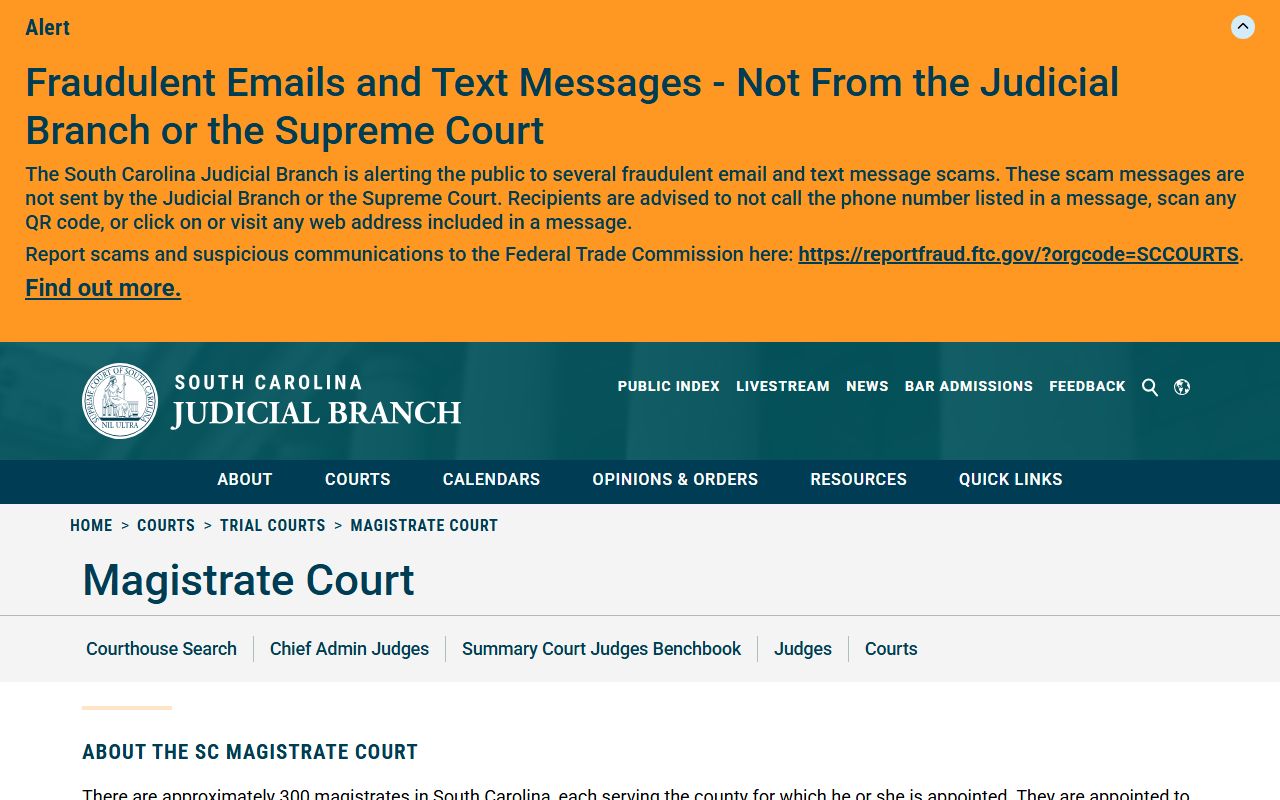
That page from sccourts.org shows the limited civil and criminal reach of the magistrate level, which is where most everyday tickets land.
Common Pleas, General Sessions, and Magistrate Courts
People mix these up often. Common Pleas and General Sessions are both parts of the Circuit Court, but they handle very different files. Magistrate Court is a separate, lower court. The table below sets the three side by side so you know where a case lives.
| Feature | Court of Common Pleas | Court of General Sessions | Magistrate Court |
|---|---|---|---|
| Type of case | Civil suits | Felonies and serious crime | Traffic, small claims, low misdemeanors |
| Money limit | Over $7,500 | Not money based | Civil up to $7,500 |
| Records held by | Clerk of Court | Clerk of Court | Summary Court Administration |
| Search tool | Public Index | Public Index | Public Index or court office |
Charleston County Courthouses
The county does not keep all court business under one roof. The Charleston County Judicial Center at 100 Broad Street holds Circuit Court, Family Court, Probate Court, and the Clerk of Court counters. Summary court business and many magistrate offices sit in North Charleston. Bond hearings, the warrants office, and the detention center share a campus on Leeds Avenue. Going to the wrong building is a common mistake, so it pays to confirm the address before a court date.
Charleston County Judicial Center
100 Broad Street, Suite 106
Charleston, SC 29401
(843) 958-5000
Summary Court Administration
4045 Bridge View Drive, Suite B-143
North Charleston, SC 29405
(843) 202-6600
Centralized Bond Hearing Court
3831 Leeds Avenue, Suite 200
North Charleston, SC 29405
(843) 746-9822
Types of Court Records Available in Charleston County
Charleston County court records cover a wide range of case types. Each court keeps its own files, and access rules differ by record. Civil and criminal Circuit Court files are the most open. Family and juvenile records carry more limits because they involve children, support, and private financial detail.
The list below shows the main record groups and the court that produces each one.
- Criminal records - General Sessions felonies and lower offenses in Magistrate or Municipal Court.
- Civil records - lawsuits, judgments, liens, and lis pendens filed in Common Pleas.
- Family and divorce records - divorce, custody, and support handled in Family Court.
- Probate records - wills, estates, and guardianships at the Probate Court.
- Traffic records - tickets and citations heard in magistrate and municipal courts.
What Charleston County Court Records Show
A court record is built from many fields. When you open a case in the Public Index, you should see the core case data and a running list of docket events. Document images may or may not be posted online. Some identifiers can be removed from the public copy on request, such as a Social Security or bank account number.
| Field | What It Shows |
|---|---|
| Case Number | The unique number assigned to the case by the court system. |
| Filing Date | The date the case was opened with the court. |
| Parties | Plaintiff and defendant, or the State and the defendant in a crime. |
| Charges / Cause | The charge in a criminal case or the legal claim in a civil case. |
| Disposition | The final result, such as dismissed, judgment, plea, or sentence. |
| Sentence / Judgment | The penalty or money award the court ordered. |
Public Access Laws for Charleston County Court Records
South Carolina gives the public a broad right to see government records, and Charleston County agencies fall under that law. The Freedom of Information Act sets the base rule for county and law-enforcement records. Court records, though, are mostly handled through the Clerk, the Public Index, and court rules rather than a formal FOIA request. If a record is sealed or made confidential by statute, a request will not open it.
Key Statutes:
S.C. Code § 30-4-30 - Gives the public a right to inspect and copy public records, with reasonable fees for search and copies.
SCACR Rule 610 - Defines judicial records and limits bulk or compiled data pulled for commercial use.
S.C. Code § 17-22-910 - Governs how qualifying criminal records are expunged through the solicitor and the courts.
Records That Are Restricted or Confidential
Not every court file is open to the public. Juvenile cases, adoption files, mental health commitments, and sealed records are closed or limited by law. Once a record is expunged, it is pulled from public view under the order that granted it. Domestic abuse details and the names of minors may also be held back.
To clear an old charge, the county uses a set path. A person arrested by the Sheriff whose charge was dropped or dismissed gets a disposition from Sheriff's Records, then takes it to the Ninth Circuit Solicitor, who decides if the case qualifies for an order of expungement. A view of the state expungement process page lays out the steps and fees.
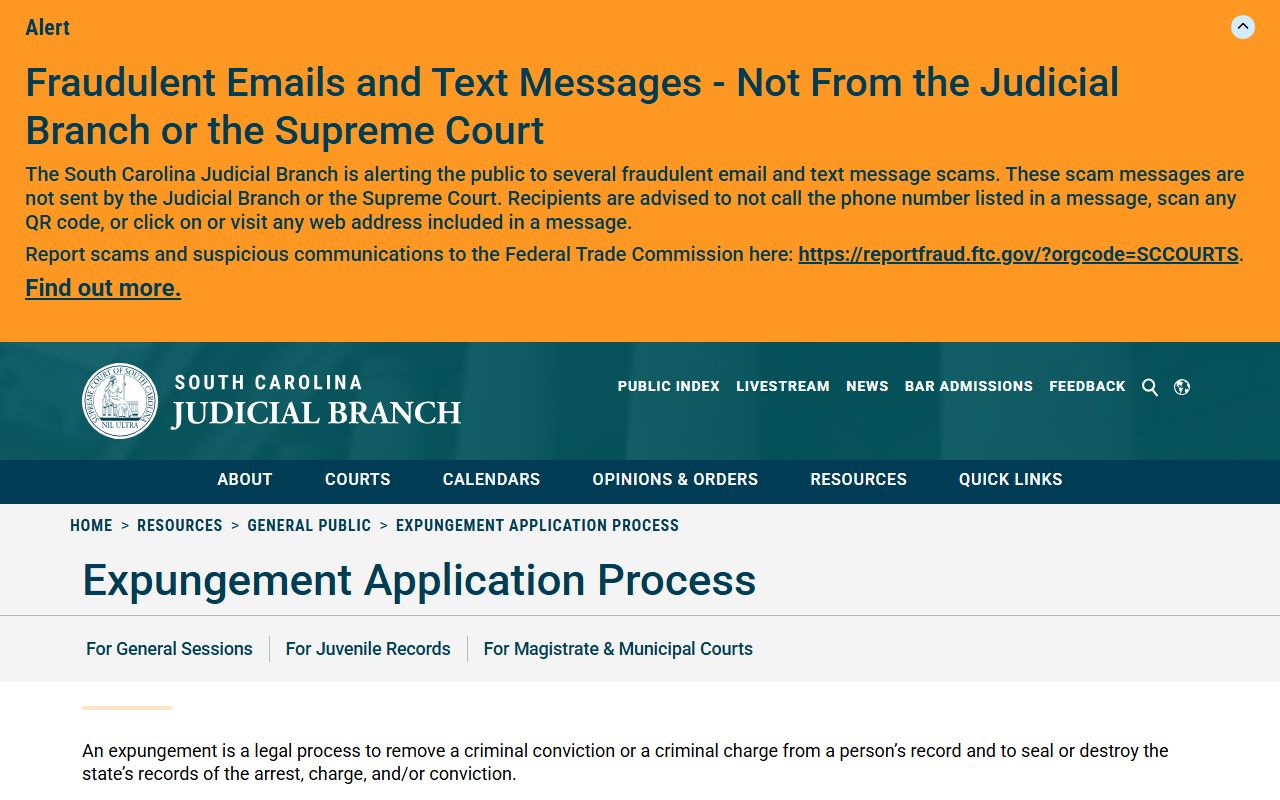
The Judicial Branch page at sccourts.org explains who reviews an application and what each office charges.
Specialty Courts in Charleston County
Charleston County runs problem-solving courts that aim to treat the cause of a case, not just punish it. The Ninth Judicial Circuit Veterans Treatment Court is a voluntary program for adults with prior military service who face criminal charges and struggle with addiction, mental illness, or trauma such as PTSD. The five-phase track runs at least 15 months, and charges can be dismissed after a person finishes. Participants appear in court weekly, meet a mentor, attend treatment, and submit to random drug testing.
The county also signals an Adult Drug Court, a Juvenile Drug Court, and a Mental Health Court through the Probate Court program list. A look at the county Drug Court material shows the treatment focus of these programs.
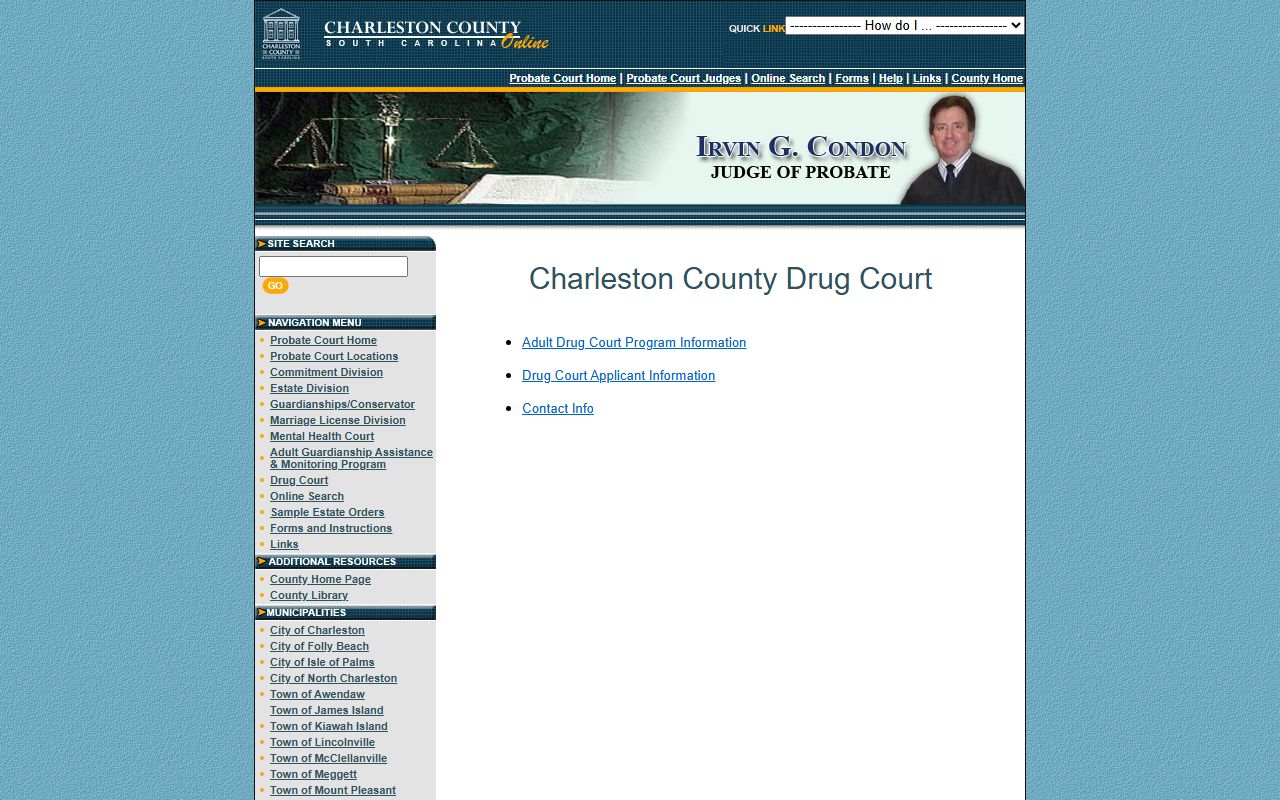
The Drug Court page at charlestoncounty.org describes close contact between the judge, the coordinator, and treatment providers.
Charleston County Sheriff and Jail
The Charleston County Sheriff's Office runs the Sheriff Al Cannon Detention Center on Leeds Avenue in North Charleston. Sheriff Carl Ritchie was elected in November 2024 and leads one of the largest full-service sheriff's offices in the state. The detention center holds people awaiting trial and people serving short sentences. Not everyone in the jail has been convicted.
You can look up people in custody, set release alerts, and check active warrants through the county systems. See Charleston County inmate records for the full roster details and warrant records for active warrants.
Marriage, Divorce, and Probate Records
Marriage and probate business runs through the Probate Court, while divorce is a Family Court matter held by the Clerk of Court. The county uses an online tool called LOVE for marriage license applications. See marriage and divorce records and probate records for the full process. A few probate terms come up often.
- Testator
- A person who makes a will.
- Executor
- The person named in a will to settle the estate.
- Conservator
- A person the court names to manage the money of someone who cannot.
Charleston County Court Records Fees
The Clerk of Court charges set fees for filings, copies, and records work. Copies are cheap per page, but certified work and record retrieval cost more. The county adds a portal fee and a convenience fee on some card payments. The table lists common charges from the Clerk schedule.
| Item | Amount |
|---|---|
| Common Pleas / domestic relations filing | $150.00 |
| Copies (xerox, computer, microfilm) | $0.11 each |
| Certificate under seal of Clerk of Court | $10.00 |
| Record retrieval | $4.00 per record |
| Motion fee | $25.00 |
| Expungement (dismissed, nol prossed, not guilty) | $35.00 |
How to Interpret Charleston County Court Records
Court files use shorthand. A charge is not the same as a conviction. A charge is what the State accuses a person of, while a conviction is a plea or finding of guilt. A case marked nol prossed means the prosecutor chose not to go on. Dismissed with prejudice means the same claim cannot be refiled. Dismissed without prejudice means it can. A disposition is the final outcome of a charge or case. When a docket shows a bench warrant, that means a judge issued it, often after someone missed court.
If a term on a record is not clear, the Clerk staff can explain procedure but cannot give legal advice. For that, talk to a lawyer or a legal aid group.
Accuracy and Record Limitations
Online records can lag behind the paper file. The Public Index may not show every document image, and recent events may post late. The Sheriff has even delayed posting some inmate booking data online to cut down on bail scams. Older cases may not be online at all and may need a trip to the Clerk's office or a records request.
Note: Always confirm a name, date, or disposition with the court office that holds the file before you rely on an online record for any serious decision.
History of Charleston County Courts
Charleston County traces its government back to 1682, when it was one of the three original counties in South Carolina. The court district around Broad and Meeting Streets is one of the oldest legal centers in the South, near the well-known Four Corners of Law. Probate history here runs deep. Copies of wills from 1671 to 1871 and estate records from 1687 to 1785 are kept in the South Carolina Room of the Charleston County Main Library, not the current Probate Court. Summary Court Administration was set up in 1977 to support the county magistrates.
Frequently Asked Questions
Where do I search Charleston County court records?
Start with the Charleston County Public Index or the South Carolina Judicial Branch case search page. Use Common Pleas for civil cases and General Sessions for serious crimes. Family Court, Probate, Magistrate, and Municipal records may sit in other systems, so confirm the right court first.
Who is the Charleston County Clerk of Court?
Julie J. Armstrong is the Charleston County Clerk of Court. The office serves Circuit Court and Family Court and keeps court records, fees, docket management, and jury support. The Clerk first won the office in 1992.
Can the Clerk give me legal advice?
No. Clerk staff cannot give legal advice or prepare your filings. Self-represented people are held to the same rules as lawyers. For help, reach out to a lawyer, the public defender for criminal matters, or a legal aid group.
More on the Charleston County Court Records FAQ page.