
How to Look Up Charleston County Jail Population Data
The main local source for Charleston County jail population data is the Charleston County Criminal Justice Coordinating Council 2025 Annual Report. The CJCC publishes this report to track jail population, bookings, pretrial and sentenced splits, charge categories, length of stay, and local versus non-local holds. The report distinguishes inmates booked on Charleston County matters from people held for other jurisdictions, which matters when reading total population numbers. The CJCC does not publish a live daily dashboard; the annual report is the county's primary compiled data release.
The Bureau of Justice Statistics at the federal level publishes the Annual Survey of Jails and the Census of Jails. These give national jail population totals, average daily populations, and rates per 100,000 residents by state and county size. BJS data lags the current year by roughly 12 to 18 months. The Vera Institute of Justice has also tracked county jail trends over many years, though its incarceration trends tool experienced access issues as of the research date. The Sheriff's Office website at charlestoncounty.gov covers detention operations and facility background. Exact population tallies require the CJCC report or a public records request to the Sheriff's Office.
Note: As of early 2026, the Charleston County Sheriff's Office implemented a delay in posting booking information online to reduce bail scams. Live online results may not reflect the current count immediately.
Sheriff Al Cannon Detention Center Capacity Overview
The Sheriff Al Cannon Detention Center at 3841 Leeds Ave., North Charleston, SC 29405 is the sole county detention facility operated by the Charleston County Sheriff's Office. The facility holds pretrial detainees, people sentenced to shorter terms, and people awaiting transfer or held for other agencies. The Sheriff's Office website notes that not all people in custody at the detention center have been convicted.
The facility has gone through capacity changes over the years. According to the official detention page at charlestoncounty.gov, the first major expansion was a four-story addition completed in 1994 that raised inmate capacity to 661. In 2020, the facility removed two modular units and the Work Camp, which lowered the inmate population by 224. A county Detention Center Expansion Fact Sheet references a total inmate capacity of 2,033 for new construction tied to a four-story jail housing expansion. That figure is drawn directly from the fact sheet and should be verified against current construction status before it is treated as confirmed operational capacity.
| Facility / Project | Address | Capacity / Population Note | Source |
|---|---|---|---|
| Sheriff Al Cannon Detention Center (1994 expansion) | 3841 Leeds Ave., North Charleston, SC 29405 | Raised rated capacity to 661 | Official detention page |
| SACDC after 2020 modular/work camp removal | Same facility | Population reduced by 224 | Official detention page |
| Detention Center Expansion (new construction) | Leeds Ave. complex | Fact sheet references 2,033 total new capacity; verify current status | County expansion fact sheet |
The detention center is accredited by the American Correctional Association. Its health care program holds accreditation from the National Commission on Correctional Health Care. Both of these credentials require independent reviews of facility conditions, staffing, and inmate care standards.
The Leeds Avenue address also serves the Warrants Office and the Centralized Bond Hearing Court at 3831 Leeds Ave., Suite 200. Bond hearings take place three times daily on weekdays and twice daily on weekends and holidays. The detention campus is separate from the Judicial Center at 100 Broad Street downtown, which is where the Clerk of Court and circuit court records are kept.
Average Daily Population
The average daily population, often called ADP, is the most common measure used to compare jail size across facilities and counties. It counts the mean number of people held each day over a set period, usually a calendar year. ADP is more stable than a single-day snapshot because it smooths out day-to-day swings caused by weekend arrests, court schedules, and large-event bookings.
Exact ADP figures for Charleston County are contained in the CJCC 2025 Annual Report. The report's tables break down the local detention population, distinguish local bookings from non-local holds, and provide year-by-year comparisons. The underlying PDF tables were not machine-readable during the research phase for this page, so no specific number is cited here. The CJCC report is the authoritative local source, and readers who need the exact ADP figure should consult that document directly. The BJS Annual Survey of Jails, published at bjs.ojp.gov, provides ADP ranges for jails in counties of similar size for comparison purposes.
A screenshot from the South Carolina statehouse code page, which governs state criminal statutes relevant to detention, appears below.
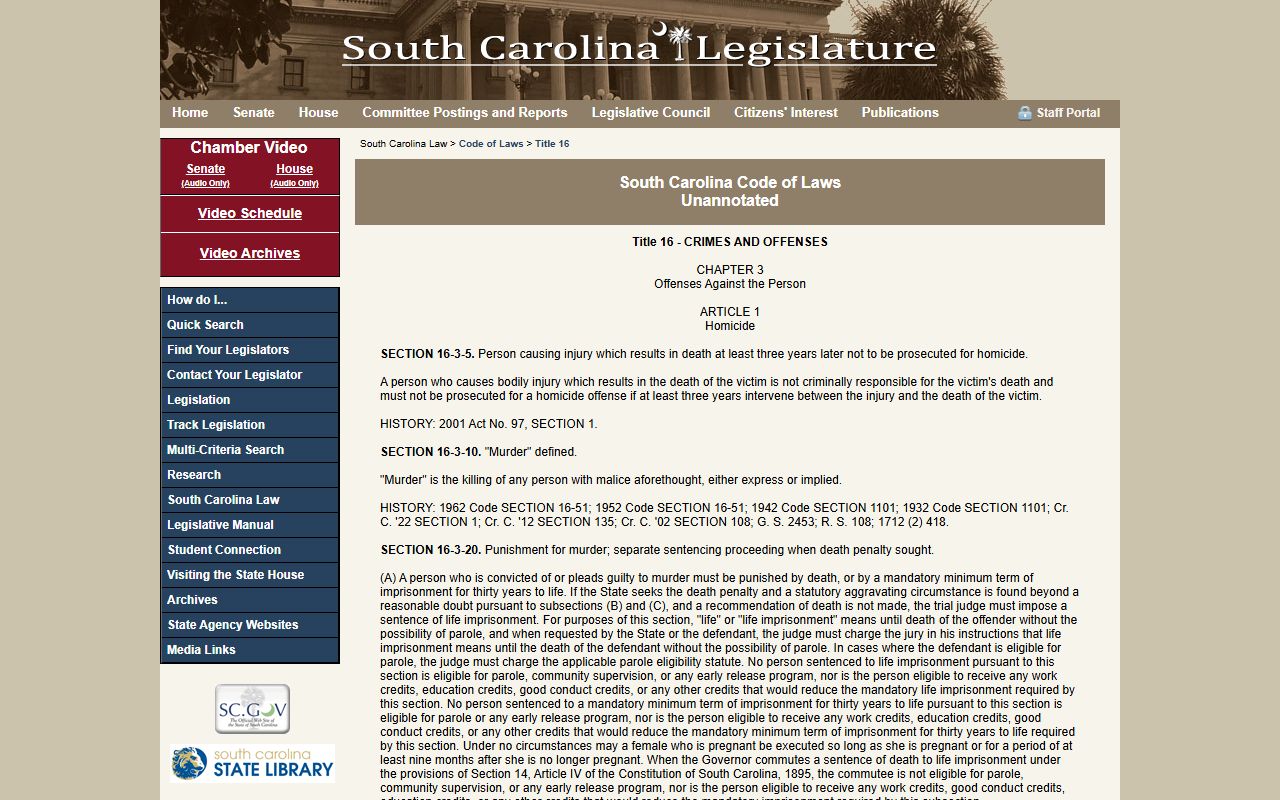
South Carolina Code Title 16, Chapter 3, referenced by the Sheriff's processing page, addresses victim notification requirements for release, escape, and transfer events that affect how the detention center reports population changes to registered victims.
Demographic Breakdown
Jail demographic data typically covers sex, race, age, and residency status. These breakdowns tell policymakers and the public which populations are most affected by pretrial detention, where the justice system is making the most contact with certain groups, and how local patterns compare to state and national trends. The CJCC 2025 Annual Report is the source for Charleston County demographic data on the detention population.
Because the annual report's tabular data was not extractable during research, specific percentages are not listed here. The known categories reported in standard county jail demographic analyses include male versus female population, race and ethnicity breakdown, age group distribution, and local versus non-local holds. For Charleston County, the CJCC report distinguishes people booked on local warrants or charges from those held for other counties or agencies, which is a meaningful distinction for understanding who is actually in county custody.
At the national level, the BJS Census of Jails shows that men consistently make up around 85 percent of the local jail population, with women accounting for about 15 percent. These are national figures. Charleston County's own breakdown should be sourced from the CJCC report. Racial and ethnic composition in jail populations nationally has shown that Black residents are held at higher rates relative to their share of the general population, a pattern documented by both BJS and the Vera Institute of Justice. Those national patterns provide context for reading the county data when it becomes available.
The Charleston County Probate Court estate division page, shown below, is one of the court offices that interacts with the justice system when people in custody or recently released have estate matters to address.
The Probate Court Estate Division handles cases such as wrongful-death settlements and minor settlements that can arise from in-custody incidents, making it a secondary resource for families affected by detention.
Pretrial vs. Sentenced Population
One of the most important distinctions in any local jail is the share of people who have not yet been convicted. Pretrial detainees are people who have been arrested and charged but whose cases are still moving through the courts. They have not been found guilty. They are held either because bond was denied, because they could not afford or did not post bond, or because bond was set at a level they did not meet. A high pretrial population share puts pressure on facilities and raises questions about the speed of the court process and the use of cash bond. The Charleston Sheriff's FAQ specifically notes that detention center inmates are innocent until proven guilty in a court of law.
Sentenced inmates are a smaller part of the typical county jail. They include people serving short sentences, usually less than one year, for misdemeanor or lower-level felony convictions. People sentenced to longer terms generally move to the South Carolina Department of Corrections. The Transportation division at the Sheriff Al Cannon Detention Center handles transfers to SCDC, federal prisons, and other facilities after sentencing. The Inactive Records section prepares General Sessions bonds and verifies jail time for released inmates, meaning it plays a direct role in the pretrial-to-sentenced and sentenced-to-released pipeline.
The pretrial versus sentenced split for Charleston County is documented in the CJCC 2025 Annual Report. National data from BJS shows that pretrial detainees typically make up between 65 and 75 percent of the average local jail population. The table below uses that national range as context, with the county-specific figure marked as requiring the CJCC report.
| Status | Charleston County | National Context (BJS) |
|---|---|---|
| Pretrial (awaiting trial or hearing) | See CJCC 2025 Annual Report | Approximately 65-75% of jail population nationally |
| Sentenced (serving a jail term) | See CJCC 2025 Annual Report | Approximately 25-35% of jail population nationally |
People who cannot make bond can pursue a bond reduction hearing through the Circuit Court. Bond hearings at Centralized Bond Court run Monday through Friday at 10AM, 2PM, and 6PM, with weekend and holiday hearings at 10AM and 2PM. Reducing the pretrial population in county jails nationally is linked to expanding pretrial release programs, bail reform, and faster case processing. The CJCC's role in Charleston County is partly to track these patterns and present them to policymakers.
Misdemeanor vs. Felony Population
County jails hold both misdemeanor and felony defendants. In Charleston County, the Sheriff Al Cannon Detention Center serves as the booking and holding facility for a range of charges. People arrested on felony charges and sent to General Sessions court will typically remain in county custody until bond is posted, a bond hearing occurs, or the case resolves. People charged with misdemeanors may also be held if bond is required or if they are pending a summary court proceeding.
Magistrate Courts in Charleston County handle criminal misdemeanor cases within their summary jurisdiction. The limit for magistrate criminal jurisdiction in South Carolina includes offenses punishable by a fine not exceeding $500 or imprisonment not exceeding 30 days, with some exceptions. More serious offenses go to the Circuit Court's General Sessions division, handled by the Ninth Circuit Solicitor's Office at scsolicitor9.org. Charge type data by misdemeanor and felony category for people held at the detention center is included in the CJCC annual report and helps explain what is driving the population at any given time.
Common charge categories tracked in county jail population reports nationally include drug offenses, property crimes, violent offenses, and failure-to-appear or probation violations. The CJCC 2025 Annual Report is the source for which categories dominate the Charleston County booking and population data. Access it at cjcc.charlestoncounty.org.
Mental Health and Medical Population
People with mental illness and substance use disorders are found in county jail populations at rates well above those in the general community. This is documented nationally by BJS and the Vera Institute of Justice. County jails often serve as de facto mental health facilities because they receive people who come into contact with law enforcement during mental health crises, substance use episodes, and related events. Managing this population requires specialized staff, treatment access, and coordination with outside health providers.
The Sheriff Al Cannon Detention Center holds accreditation from the National Commission on Correctional Health Care, known as NCCHC. This accreditation requires the facility to meet standards for medical, mental health, and dental care provided to people in custody. NCCHC-accredited facilities are required to conduct health screenings at intake, refer people with serious mental illness to appropriate treatment, manage chronic conditions, and follow protocols for suicide prevention. The ACA accreditation covers the broader correctional operations side.
Charleston County's Probate Court handles involuntary commitments for mental illness and substance abuse. People who come through the criminal justice system may also end up in Probate Court commitment proceedings if the court determines civil commitment is appropriate. The intersection of the detention center and the Probate commitment process means that some people move between criminal and civil mental health tracks. Exact numbers of people in the detention center receiving mental health or medical care are part of the CJCC annual reporting and NCCHC accreditation documentation. The Sheriff's Office at (843) 529-7300 can direct specific inquiries about health-care services within the facility.
The U.S. District Court for the District of South Carolina has also been a venue for civil rights litigation related to jail conditions. A view of that court's official page appears below.
The U.S. District Court for the District of South Carolina has jurisdiction over federal civil rights cases, including prisoner civil rights matters, and handles federal cases tied to Charleston County defendants or facilities.
National and State Context
Jail incarceration rates are measured per 100,000 residents to allow comparison across counties and states of different sizes. The Bureau of Justice Statistics is the federal agency that publishes these figures. Its Annual Survey of Jails covers roughly 900 jails across the country each year, and its Census of Jails covers all facilities every five to six years. The most recent BJS data puts the national local jail incarceration rate at roughly 220 to 230 per 100,000 residents, though this number moves based on survey year and methodology. South Carolina tends to track near or above the national average based on historical BJS data, though rates vary significantly by county within the state.
The Vera Institute of Justice has for many years published county-level jail population trend data. While the Vera incarceration trends tool was not accessible during the research phase for this page, Vera's published research notes that the growth of pretrial detention from the 1970s onward drove most of the increase in local jail populations across the country. That context is relevant for Charleston County, which has seen both population growth and detention facility changes over recent decades.
| Level | Jail Population per 100,000 Residents | Source |
|---|---|---|
| Charleston County | See CJCC 2025 Annual Report for local rate | CJCC / Sheriff's Office |
| South Carolina (state average) | Tracks near or above national average historically | BJS Annual Survey of Jails |
| National average | Approximately 220-230 per 100,000 (BJS, recent surveys) | Bureau of Justice Statistics |
To check current BJS data, go to bjs.ojp.gov and search the jails section. BJS publishes both summary data tables and full statistical reports. The Vera Institute, while not linked here due to access issues, can be found by searching "Vera Institute incarceration trends" and is a widely cited source for county-level jail comparisons over time. The South Carolina Bar's public legal help page is also useful for people seeking to understand their rights during detention.

The South Carolina Bar public legal help page connects people with legal aid, referral services, and self-help resources, including assistance for those dealing with detention, bond, or court proceedings in Charleston County.
Population Trends Over Time
The Charleston County detention population has shifted at several points in recent history. The 1994 four-story addition was the facility's first major capacity increase, bringing the rated bed count to 661. In 2020, the removal of two modular units and the Work Camp reduced the facility's operational population by 224. These structural changes directly affected how many people the county could hold at any given time. More recently, a county Detention Center Expansion Fact Sheet points to a planned or underway construction project referencing 2,033 new capacity beds, though the completion and operational status of that expansion requires verification.
On the population side, Charleston County is South Carolina's third most populous county and continues to grow. The Sheriff's Office website describes the county as serving a geographically large area with 90 miles of coastline and steady population growth, including downtown Charleston, North Charleston, Mount Pleasant, and coastal communities. As the county population grows, arrest volumes and jail bookings tend to rise, which puts pressure on a fixed-capacity facility. The CJCC was formed partly to track these trends and coordinate among the Sheriff, courts, solicitor, and public defender to manage the system as a whole.
Recent policy and oversight factors also affected the trend picture. In early 2026, the Charleston County Sheriff's Office began delaying the posting of online booking data to reduce bail scams. This change means the online inmate search at inmatesearch.charlestoncounty.gov may not reflect real-time population changes. Local reporting and a SLED review followed an in-custody death at the detention center. Federal and state scrutiny of South Carolina jail conditions has also been reported in the AP and local news, covering Charleston County among other facilities. These developments underscore that the detention population is not just a number; it reflects ongoing decisions about safety, oversight, and facility management.
The CJCC 2025 Annual Report should contain multi-year booking data and ADP trends. For anyone tracking the population over time, the CJCC report at cjcc.charlestoncounty.org is the starting point. Supplementary national trend data is available from BJS, which tracks how local jail populations have moved decade by decade across the country.
Searching for Charleston County Inmate Records by Name
This page covers aggregate Charleston County jail population data, not individual inmate lookups. To search for a specific person currently or recently held at the Sheriff Al Cannon Detention Center, use the Charleston County inmate records portal, which lets you search by name, booking date, arrest date, inmate number, and Soundex. That tool is operated by the Sheriff's Office and covers current bookings and past bookings through the Show Past Bookings option. Population figures on this page are drawn from county and national reports and do not represent individual custody status.
Where the Data Comes From
Charleston County jail population data has several layers. At the local level, the primary source is the Charleston County Criminal Justice Coordinating Council. The CJCC brings together the courts, Sheriff's Office, solicitor, public defender, and other agencies to coordinate on criminal justice policy. Its annual report is the main published document for local jail metrics, including ADP, pretrial share, demographic breakdown, booking counts, and local versus non-local holds. The 2025 report is available at cjcc.charlestoncounty.org.
At the state and national level, the Bureau of Justice Statistics at bjs.ojp.gov is the federal statistical agency responsible for jail and prison data. Its Annual Survey of Jails and the less-frequent Census of Jails are the benchmarks for comparing county jail populations across the country. The Vera Institute of Justice has also published extensive county-level jail trend analysis. Vera's work is widely cited in policy discussions, though the Vera incarceration trends tool had access issues at the time this page was researched; Vera can be found by name through a web search. Together, these sources form the data chain from local booking desk to national incarceration statistics.
- Charleston County CJCC 2025 Annual Report: local jail metrics, pretrial and sentenced split, booking counts, and demographic data
- Bureau of Justice Statistics (BJS): national jail population, rate per 100,000, Annual Survey and Census of Jails
- Vera Institute of Justice: county-level jail trend analysis over multiple decades
- Charleston County Sheriff's Office: facility history, capacity changes, accreditation, and operational updates
- South Carolina Judicial Branch and CJCC partners: court processing data that drives pretrial detention length
For Charleston County criminal records tied to court case outcomes, the Clerk of Court and the Public Index are the sources. The CJCC report connects the arrest and detention data to the broader picture of how cases move from booking through the courts. For people released from the facility, the released inmates page covers verification tools including the VINE notification service and the SCDC inmate search for people transferred to state custody. Questions about individual cases can also be directed to the FAQ page, which covers common questions about the detention center, bond hearings, and how the local jail system operates.