
How to Find Recently Released Charleston County Inmates
Charleston County's official inmate search at inmatesearch.charlestoncounty.gov is the primary tool for verifying release from the Sheriff Al Cannon Detention Center. By default, the portal shows only people who are currently in custody. To find a person who has already been released, check the box labeled "Show Past Bookings" before you submit your search. That setting opens the results to prior stays and lets you see booking dates, arrest dates, and whether an entry is marked as an active or closed booking. You can also narrow results by setting a booking date range or an arrest date range, which helps when you know roughly when someone was taken in. The form uses reCAPTCHA, so you will need to complete the captcha check before results load.
Keep in mind that Charleston County Sheriff's Office implemented a delay in posting new booking information to combat bail scams. Recently booked individuals may not appear online right away. For current release status, a call to the detention center is faster than the portal alone.
Two internal units handle release at the Detention Center. Records Releasing interprets court-issued commitments, bonds, and orders, and confirms timely release. Out Processing returns personal property and valuables. The detention center processing page explains each division's role.
Setting Up Release Notifications (VINELink)
South Carolina runs its victim notification program through SAVIN, the state version of VINELink. Under S.C. Code § 16-3-1530, agencies with custody of an accused offender must make a reasonable attempt to notify requesting victims when that person is released, transferred, or escapes. VINE is how the Charleston County Sheriff's Office meets that duty. The service is free and confidential.
Registration is done by phone or through savin.sc.gov or vinelink.com. VINE asks for your phone number and a four-digit PIN. You can add more than one number. When custody status changes, VINE calls each number. If no one answers, calls continue for up to 24 hours until the PIN is confirmed. Call (866) 727-2846 to register by phone.
- Go to savin.sc.gov or vinelink.com and select South Carolina.
- Search for the offender by name or inmate number.
- Select the record and choose to register for notifications.
- Enter your phone number and create a four-digit PIN. Add a backup number if needed.
- Confirm. VINE notifies you whenever custody status changes.
Note: VINE covers release, transfer, and escape events. Keep contact information current so calls reach you.
Searching State and Federal Released Inmates (SCDC and BOP)
Some people booked at the Sheriff Al Cannon Detention Center are later transferred to the South Carolina Department of Corrections to serve a state sentence. Others face federal charges and move into Bureau of Prisons custody. Once a person leaves county custody, two separate databases cover their status.
The SCDC public inmate search covers people in state prison. The main SCDC site is doc.sc.gov. Clicking a result row shows the SCDC ID, SID, name, location, sentence information, admission date, and projected release date. The table below lists the SCDC search fields.
| Field Label | Type | Required | Notes / Format |
|---|---|---|---|
| SCDC ID | Text | No | Enter the SCDC number if known; fastest lookup method. |
| SID | Text | No | State Identification number; optional if name or SCDC ID used. |
| First Name | Text | No | Leave blank if unsure; the system accepts partial searches. |
| Last Name | Text | No | Use full first and last for best results. |
| Phonetic Match | Checkbox | No | Returns similar-sounding names when spelling is uncertain. |
| Submit | Button | n/a | Runs the search; Help link explains field use. |
The Charleston County Probate Court homepage is a useful reference for seeing how the county's separate courts divide responsibilities, which helps clarify why a person who left county custody may need to be searched in SCDC or BOP rather than the local portal.
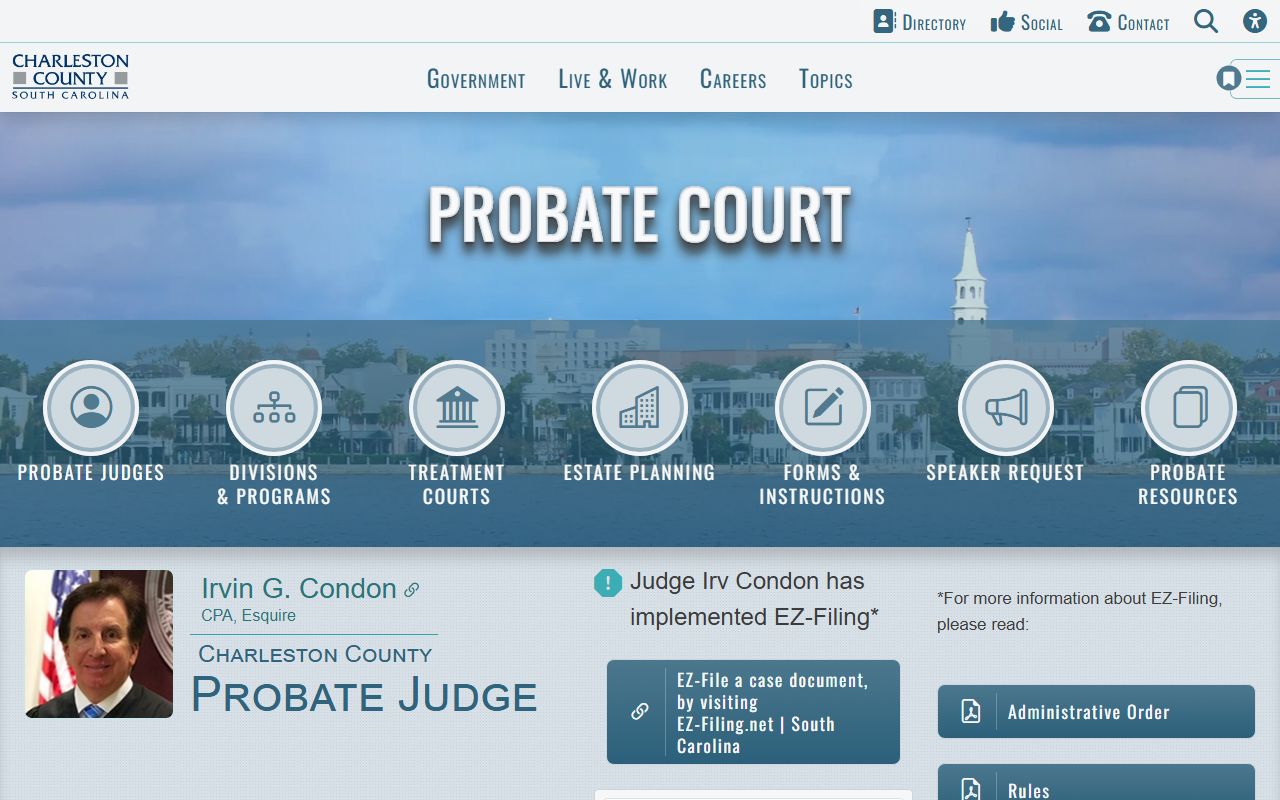
Each Charleston County court handles a distinct function, and knowing whether a person went to state prison, stayed local, or faces federal charges determines which database to check.
For federal inmates, the Bureau of Prisons inmate locator covers people in BOP custody past or present. The BOP locator supports two search modes: by number or by name. The table below lists the fields in the BOP form.
| Field Label | Type | Required | Notes / Format |
|---|---|---|---|
| Find by Number | Radio / Tab | No | Accepts BOP Register Number, DCDC number, FBI number, or INS number. |
| Number | Text | Yes (if number search) | Exact identifier required for the number-search mode. |
| Find by Name | Radio / Tab | No | Switch to name mode when you do not have a register number. |
| First Name | Text | Yes (if name search) | Required for the name-search mode. |
| Middle Name | Text | No | Optional; narrows results when many share a first/last name. |
| Last Name | Text | Yes (if name search) | Required for the name-search mode. |
| Race | Dropdown | No | Optional demographic filter to narrow a common name. |
| Age | Text | No | Numeric; helps distinguish people with the same name. |
| Sex | Dropdown | No | Male or Female filter. |
| Search | Button | n/a | Runs the federal inmate query. |
The BOP locator screenshot below shows the federal search tool that covers any Charleston County resident who entered federal custody.
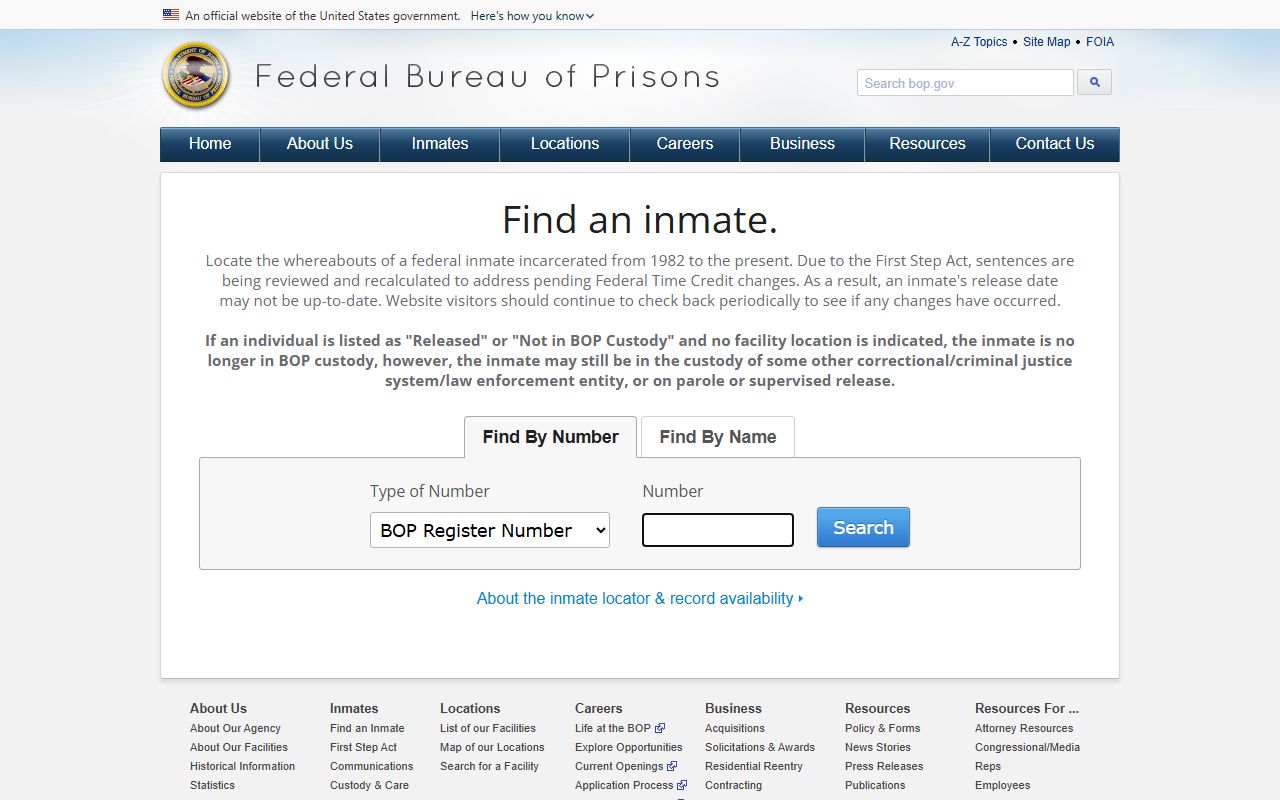
The BOP locator covers inmates in all federal facilities across the country, not just those in South Carolina, which matters because federal prisoners can be housed far from where they were charged.
Verifying Release in Person or by Phone
Call the Sheriff Al Cannon Detention Center at (843) 529-7300 to confirm a release. After hours the number is (843) 202-1700. The Records Releasing unit handles court-issued commitments and orders and can confirm whether a person has been processed out. For victim advocates, the Victim Witness line is (843) 529-7471.
In-person verification is possible during regular hours at 3841 Leeds Ave., North Charleston, SC 29405. The Leeds Avenue campus is separate from the downtown Judicial Center at 100 Broad Street, which handles Circuit Court and Family Court. Detention and release questions go to Leeds Avenue, not downtown.
The warrant search page at charlestoncounty.gov/departments/sheriff/warrants-search.php is a related tool you may want to check. If you are looking for someone who was released and may still have an open warrant, the warrant search shows last-name results for active warrants reported by the Sheriff's Office. As with the inmate search, results are not official confirmation. The official screenshot below shows the warrant search interface.
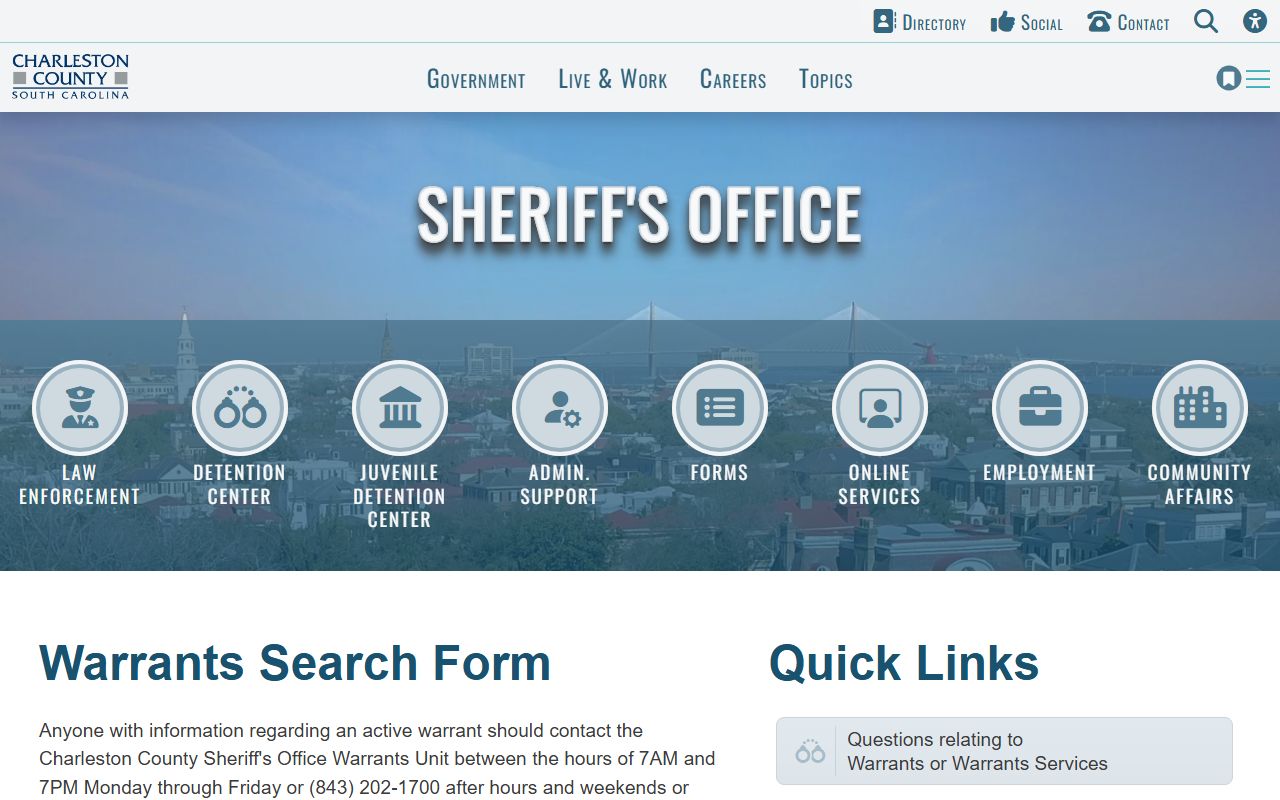
Checking the warrant search alongside the inmate portal gives a fuller picture of someone's status: whether they left custody and whether any active warrant is still on file.
For current inmate records, use the county inmate search without the past-bookings flag, which shows only people still in custody at the detention center.
The Sex Offender Registry (SLED)
South Carolina's Sex Offender Registry is maintained by the State Law Enforcement Division, known as SLED. When a person convicted of a qualifying sex offense is released, registration is required. The registry is searchable at sled.sc.gov/state-sex-offender-registry after agreeing to conditions of use and completing a captcha. The tool is called SORT.
SORT profiles show multiple photographs taken over time, a map of where the person lives, past aliases, and a list of sex-offense convictions. The SLED page warns that data changes quickly and may not reflect a current address at the moment of search. The registry also offers community notifications so users can receive alerts when a registrant moves into or out of a specific area. VINE covers release from custody; SLED notifications are address-based and focus on residence changes after release.
Note: Absence from SORT results does not confirm no sex-offense conviction. Verify directly with SLED when accuracy is critical.
Parole and Probation Information
After release from state prison, many people in South Carolina are supervised by the South Carolina Department of Probation, Parole and Pardon Services, known as DPPPS. The agency handles post-release supervision for people paroled from SCDC, probation for people on community sentences, and pardon applications. For someone released from the Sheriff Al Cannon Detention Center on a local sentence, supervision depends on what the court ordered. People transferred to SCDC and then paroled come under DPPPS when they return to the community.
DPPPS does not publish a public supervision search. Contact the agency directly with questions about a specific person. Parole and probation violations can result in arrest and return to custody.
SC Dept. of Probation, Parole and Pardon Services
Handles parole, probation supervision, and pardon applications. Contact through the site to reach a local Charleston area office.
Reentry Resources in Charleston County
People leaving the Sheriff Al Cannon Detention Center or returning to Charleston County after a state or federal sentence face practical challenges. Housing, employment, and legal status questions come up fast. Several organizations help with the transition.
SC Legal Services at lawhelp.org/sc is a starting point for civil legal questions. The organization assists low-income individuals with housing, benefits, family law, and related matters. The South Carolina Bar's public legal help page connects people with referral services for those who do not qualify for free aid but still need guidance.
The Charleston County Public Defender handles state criminal defense for qualifying defendants. If a person released from custody still has pending charges, call (843) 958-1850. The screenshot below shows the Public Defender's page.
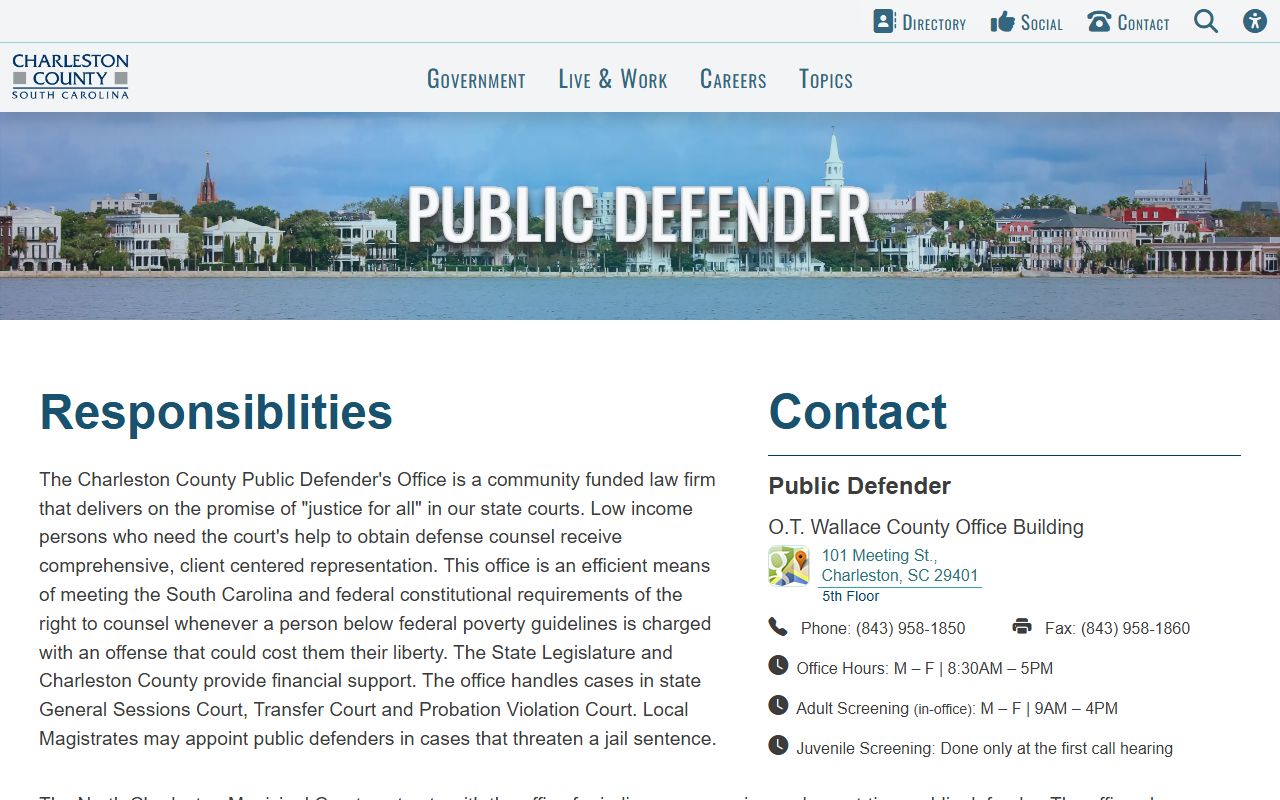
The Public Defender's role is court representation; for non-criminal civil issues after release, SC Legal Services and the Bar referral service are the better starting points.
Charleston County Public Defender
charlestoncounty.gov/departments/public-defender
(843) 958-1850
State criminal defense for qualifying defendants with pending charges or post-release hearings.
- SC Legal Services / LawHelp - free civil legal help for low-income individuals, including housing, benefits, expungement, and family law.
- South Carolina Bar public legal help - referral service connecting individuals to licensed attorneys statewide.
- South Carolina Department of Corrections - SCDC provides reentry resources for people leaving state prison, including programming and transition planning.
- SC Dept. of Probation, Parole and Pardon Services - supervision, pardon applications, and transition support for people on state supervision.
Civil Rights Restoration After Release
In South Carolina, people with felony convictions generally regain the right to vote after completing their full sentence, including any probation or parole. The right does not come back automatically at the moment of release from jail if supervision continues. Once parole and probation are finished, voting rights are restored without a separate petition. Confirm current eligibility through the South Carolina Election Commission before the next registration deadline.
Firearm rights involve both state and federal law. Federal law bars people with felony convictions from possessing firearms regardless of any state action. A DPPPS pardon can restore some state-law rights but does not remove the federal bar. Get legal advice before handling a weapon after any felony conviction.
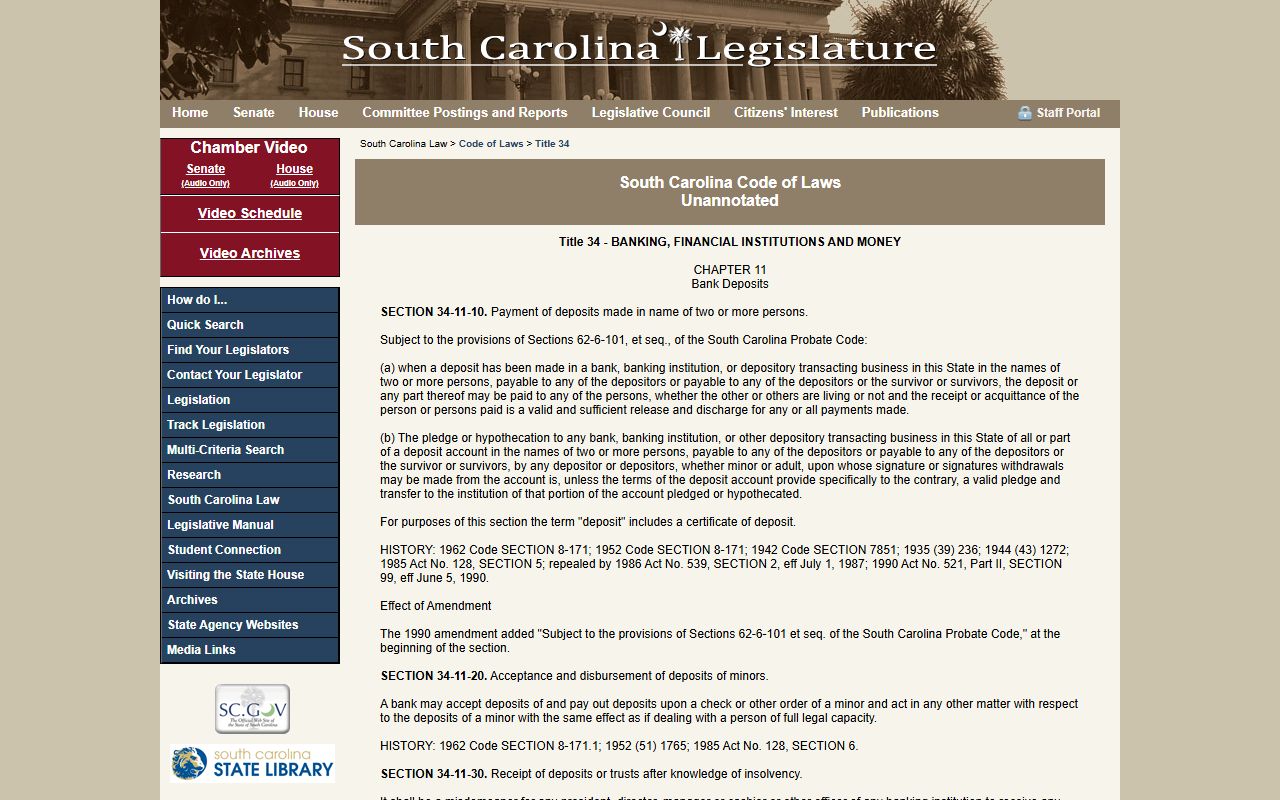
Expungement may help when charges were dropped or resulted in a not-guilty verdict. In Charleston County, the process starts with getting a disposition from Sheriff's Records and bringing it to the Ninth Circuit Solicitor's Office. One specific statutory route for check-related offenses is S.C. Code § 34-11-90(e), which is one of several expungement provisions the Solicitor evaluates. The screenshot below shows the South Carolina state legislature page for that statute.
Eligibility rules are narrow. A call to the Solicitor's Office confirms whether a record qualifies.
For inmate population data, see the inmate population page. For the booking process and search fields, see inmate records. Active warrants go through the warrant records search. Case history questions belong on the arrest records page.